


Mechanism case. This page explains how the workflow runs, without a published metric. The listing below is an illustrative record, not a seller’s real submission.
A marketplace listing is a set of claims a seller makes about a product. Catalogue QC decides which of those claims the evidence supports before a shopper sees them. Here is one listing, annotated step by step.
1. What the seller supplied
| Field | Seller value |
|---|---|
| Title | Insulated steel water bottle, 1 litre, blue |
| Category | Kitchen › Bottles and flasks |
| Material | Stainless steel |
| Capacity | 1 litre |
| Colour | Blue |
| Images | 3: front, side, base with printed label |
2. What BergAuto checks
BergAuto runs the attribute and image checks before anything is published:
- Completeness: every attribute the category requires is present. Pass.
- Category: the image classifier agrees the product is a bottle or flask. Pass.
- Colour: the front and side images show a blue body. Pass.
- Material: the images are consistent with a metal body; nothing contradicts the claim. Pass.
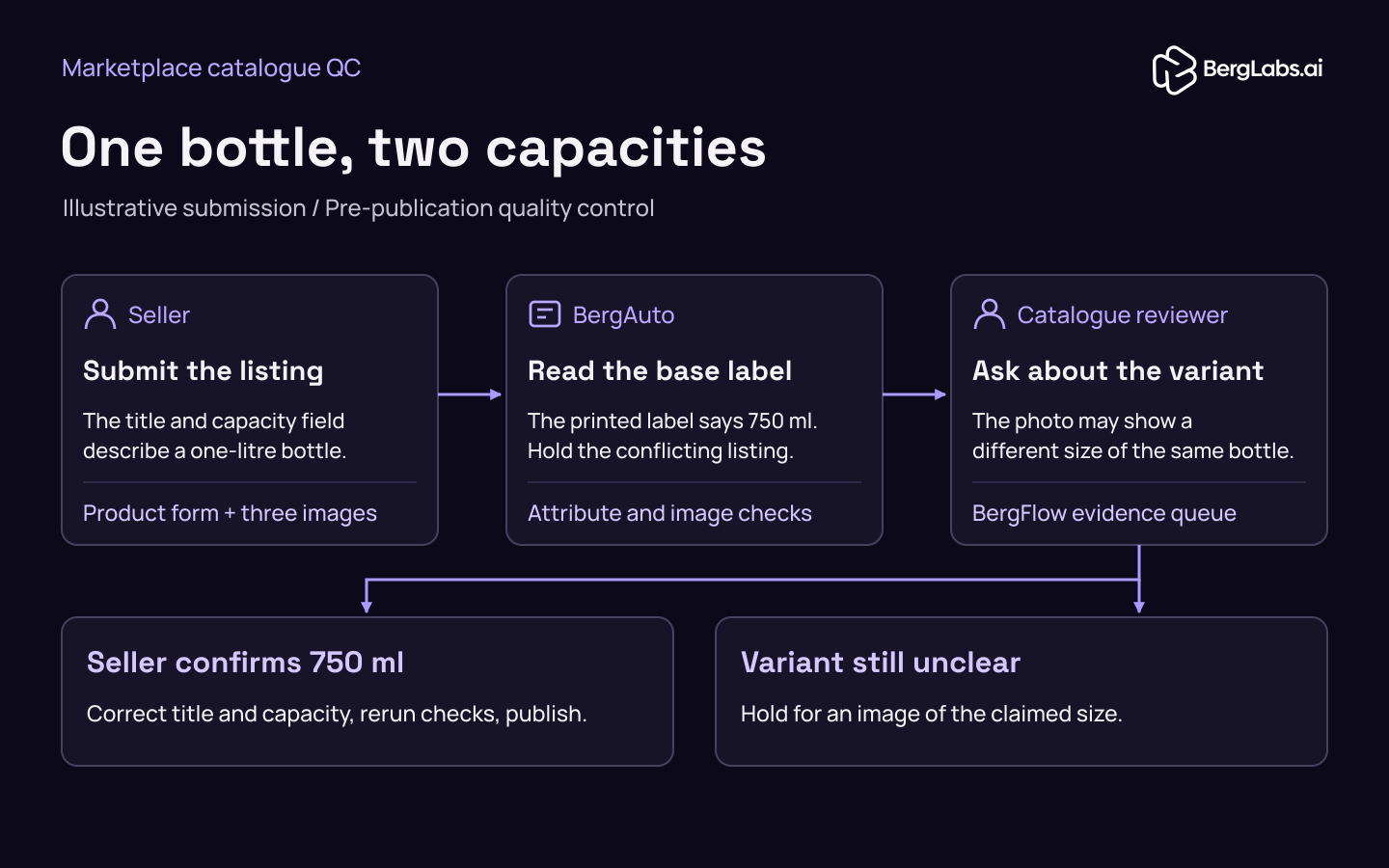
- Capacity: the label on the base image reads 750 ml. The seller value says 1 litre. Conflict.
3. The conflict
The image supports most of the listing but contradicts one material fact a shopper relies on. BergAuto does not choose between the two values. It holds the listing and opens an exception in BergFlow, attaching the seller value, the base image with the label region marked and the rule that failed.
4. Who resolves it
A catalogue reviewer in BergFlow sees the claim and the evidence side by side. The reviewer has four options: accept the seller value, correct it, reject the listing or request information from the seller. Here the image is clear but the seller might have uploaded a photo of a different size variant, so the reviewer requests confirmation with a specific reason: “Capacity on the product label reads 750 ml. Please confirm the capacity or upload an image of the 1 litre variant.”
5. The publish decision
The seller confirms 750 ml. The reviewer corrects the capacity and the title, and the checks run again. All pass, and the listing is published. The record keeps the original value, the image evidence, the request, the seller’s reply, the corrected value, the reviewer and the rule version, so the decision can be explained later.
What the case covers and what it does not
Case 17 documents the mechanism: automated checks on BergAuto, exceptions reviewed in BergFlow before publication. It reports no metric. The published outcomes from BergLabs’ marketplace work belong to their own engagements: the search relevance case, with its 1.2M+ catalogue corrections, and the seller onboarding case each report their own results.
