


Mechanism case. This page explains how the workflow runs, without a published metric. The query, products and judgements are illustrative. The client’s full rubric is not public; the match grades below follow the perfect-match and partial-match judgements used in BergFlow query-product tasks.
Relevance labels are only useful if two reviewers looking at the same pair reach the same answer. A calibration exercise tests that before a batch starts, and the senior reviewer’s ruling is what keeps the next batch consistent.
The rubric
| Grade | Meaning |
|---|---|
| Perfect match | The product is what the query asks for and meets every attribute the query states. |
| Partial match | The right kind of product or a close substitute, but it misses a stated attribute or is an adjacent product type. |
| Not relevant | A different product, or one a shopper with this query would not consider. |
One query, three products
Query: “waterproof hiking boots men”
| Product | Judgement | Reason |
|---|---|---|
| A. Men’s leather hiking boot, waterproof membrane | Perfect match | Right product type, gender and the stated waterproof attribute. |
| B. Men’s water-resistant trail running shoe | Partial match | Adjacent product type, and water-resistant does not meet waterproof. |
| C. Merino hiking socks | Not relevant | An accessory, not footwear the query asks for. |
The disagreement
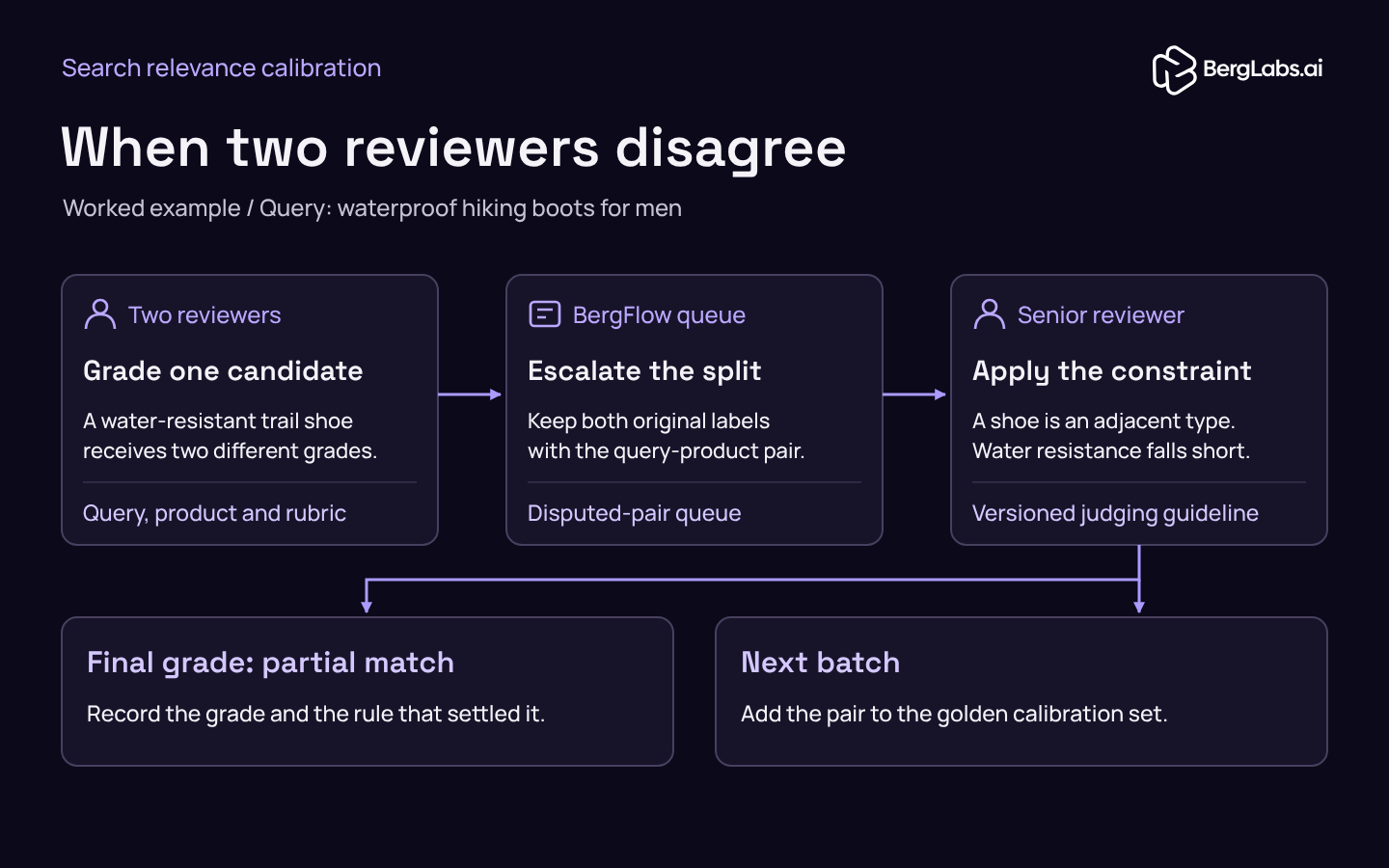
Two reviewers split on product B. The first marked it a perfect match: it is men’s footwear built for trails and handles wet ground. The second marked it partial. The pair went to a senior reviewer, as every disputed pair does.
The rule that resolves it
The senior reviewer applied two rules. First, an attribute the shopper typed is a hard constraint: “water-resistant” does not satisfy “waterproof”. Second, an adjacent product type, a shoe for a boot query, caps the grade at partial. Product B is a partial match.
What the senior reviewer records
- The pair, both original labels and the final label.
- The rule applied, written as a sentence the next reviewer can apply without asking.
- The pair added to the golden set as a worked example of the rule.
- A guideline version number, so later disagreements can be traced to the version the reviewers used.
The next batch starts with the updated guideline, and the golden set checks that reviewers apply the ruling the same way.
Where the outcome lives
Case 18 documents the judging mechanism and reports no metric. The 46% to 26% search-pain result belongs to BergLabs’ search relevance engagement and is reported in that case.
