
FULL-STACK DATA OPERATIONS LAYER · PRODUCTION AI · 300% YOY OPS GROWTH
The Operating Layer Behind Production AI
BergLabs combines BergFlow, BergAuto, and focused applications so production AI has controlled records, governed automation, human review, audit trails, and measurable outcomes.
The full-stack data operations layer behind production AI.
BergFlow controls records. BergAuto automates the steps that move them. Six applications: Rosterr, Quinn, Charterr, Sirenn, Radarr, Atlass. One aligned system.
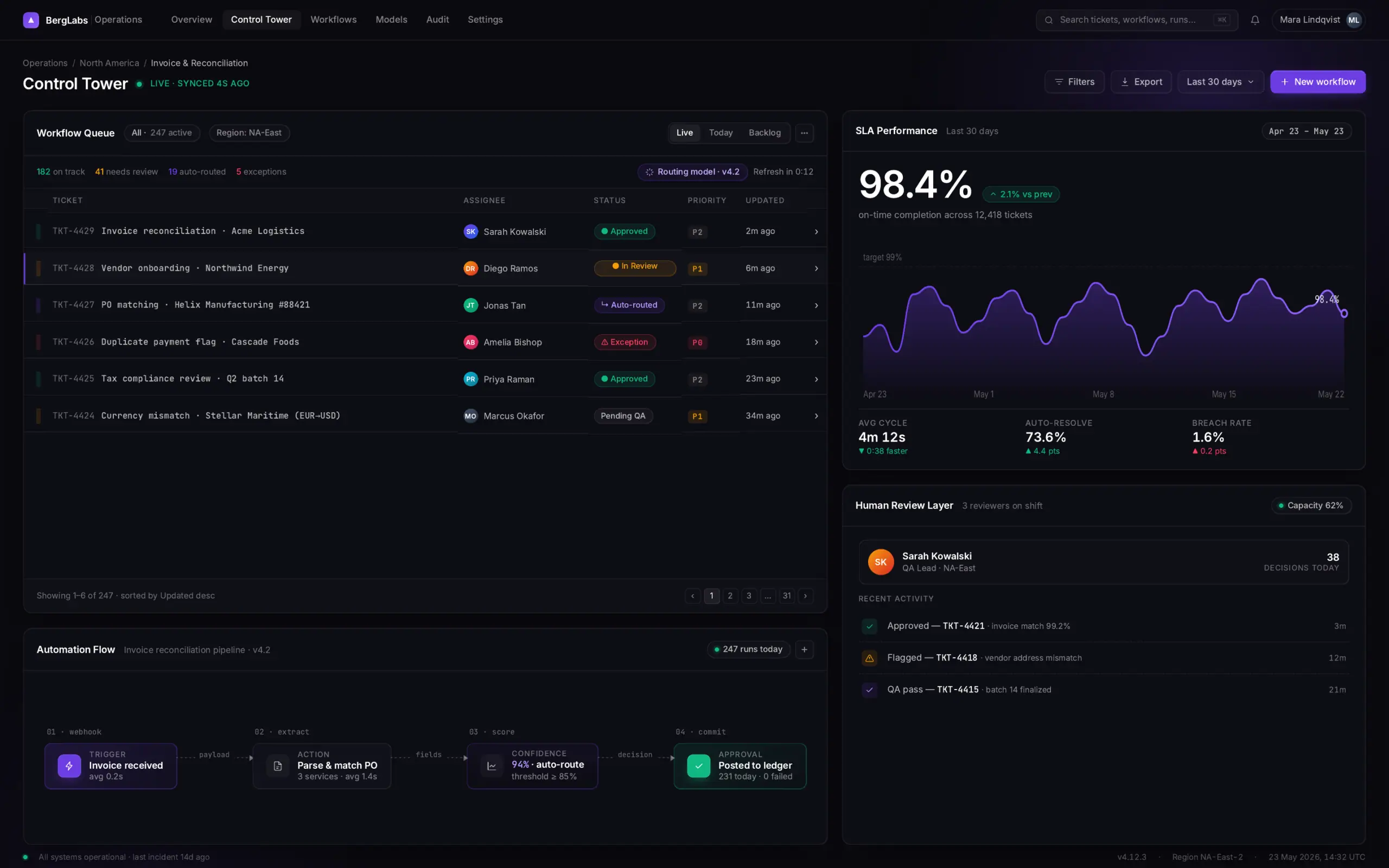
Architecture
Two platforms. Six applications. One operating layer.
The live architecture behind every BergLabs workflow.
BergFlow holds the records. BergAuto runs the governed steps. Six applications put them to work.
Two ways to start
Automate the routine. Hand us the queue. One operating layer.
AI handles the repeatable step.
BergLabs owns the queue.
Workflow automation
AI runs the repeatable steps - extraction, drafting, routing. Every action carries a confidence score: at or above 94 it auto-clears; below that, exceptions and edge cases route to a specialist. You keep the speed, and every decision stays audit-logged.
Learn more →Managed operations
BergLabs owns the live queue end to end. We deploy specialist pods, staff review, and hold SLA and QA on your records. You get a named team, the same review discipline and audit trail, and a weekly readout on outcomes.
Learn more →OPERATING MODEL
What the Intelligent Ops Layer means.
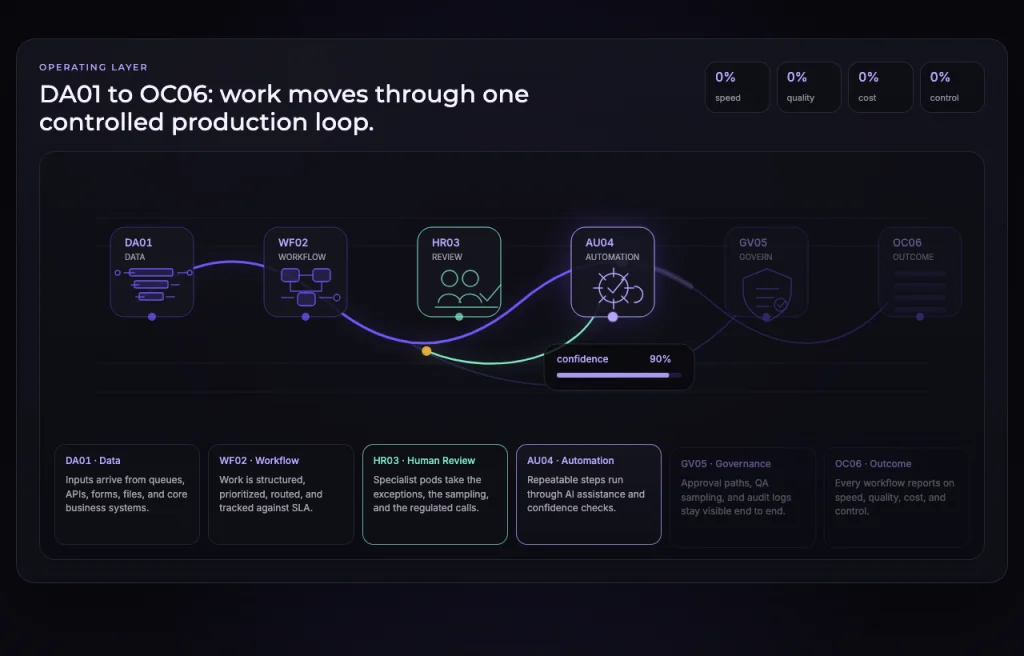
It is the operating model behind production AI: structured inputs, managed queues, trained reviewers, automation rules, QA checks, exception paths, and measurable outcomes working as one system.
01
Structured inputs
Tickets, documents, and events intake into one controlled record before any work begins.
02
Governed automation
High-confidence work auto-clears; humans review only the exceptions that fall below the gate.
03
Measured outcomes
Every enterprise function is measured, so quality and delivery stay legible over time.
Representative figures - results vary by workflow and project.
THE INTELLIGENT OPS LAYER
The Operating Model Behind Production AI
Controlled records, workflow automation, specialist review, app-layer execution, and reporting - joined in one accountable loop.
BUILT AROUND THE FUNCTIONS YOUR TEAM SELLS INTO
Choose the workflow you want to improve first.
Every department gets a focused entry point: ticket triage, lead routing, invoice checks, onboarding, contract support, and helpdesk automation.
CX & Customer Ops
Ticket triage, conversation routing, and SLA-backed support operations.
Explore →Sales & Marketing Ops
Lead enrichment, routing, campaign QA, and revenue-workflow support.
Explore →Finance & Accounting Ops
Invoice checks, reconciliation, approvals, and exception queues.
Explore →HR & People Ops
Onboarding, document review, workforce operations, and QA loops.
Explore →Legal & Compliance Ops
Contract support, audit review, policy checks, and controlled approvals.
Explore →IT Ops & Helpdesk
Helpdesk triage, access-request workflows, and automation support.
Explore →Use case preview
Workflows you will recognize in ten seconds.
Same operating loop. Three functions where it already runs in production.
PROOF
Outcomes worth scanning.
Proof across data, managed operations, and automation.
Every label human-reviewed across five data modalities.
Pilots ramp to full-volume production without losing the thread.
~99.2% SLA and ~1.9% exceptions, measured at the function level.
Representative figures - results vary by workflow and project.
4-WEEK PILOT TIMELINE
Start with one workflow.
In four weeks, we diagnose the workflow, design the operating model, deploy a pilot pod or automation flow, and benchmark speed, quality, cost, and control.
Diagnose
Workflow audit and bottleneck mapping.
Design
Operating model and system blueprint.
Deploy
Pilot pod or automation flow goes live.
Measure
Speed, quality, cost, and control, benchmarked.
READY TO RUN A WORKFLOW
Start with one workflow. Scale AI ops across every function.
Pick one function, one workflow, one success metric. We prove the model before scaling across departments.