
The Intelligent Ops Layer
The operating model for enterprise AI workflows.
BergFlow and BergAuto pair record control with workflow automation. Six applications keep review, execution, audit, and reporting aligned in production.
Operating model
What the Intelligent Ops Layer means.
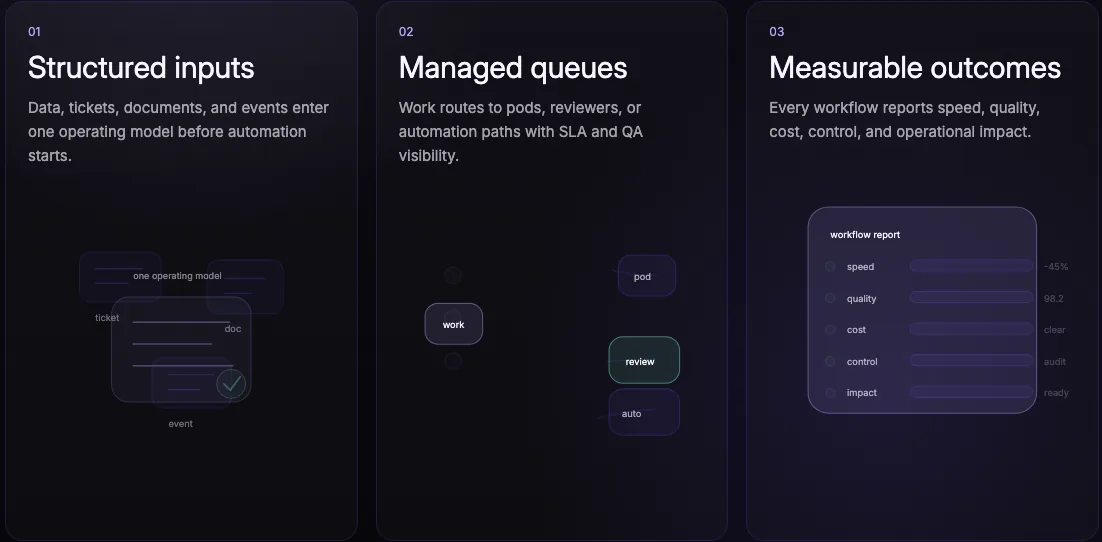
It is the operating model behind production AI: structured inputs, managed queues, trained reviewers, automation rules, QA checks, exception paths, and measurable outcomes working as one system.
01
Structured inputs
Work arrives with context, owner, source, SLA, and evidence attached.
02
Managed queues
BergLabs runs the workflow with clear routing, review lanes, and escalation paths.
03
Measurable outcomes
Every workflow reports speed, quality, cost, control, and business impact.
Operating loop
Intake, structure, route, assist, review, log, measure.
Each step is visible, owned, and designed for the places where AI needs human judgment, clean data, and audit-ready records.
Connected operating model
Two platforms and six applications run the layer.
BergFlow and BergAuto keep the platform layer controlled; Rosterr, Quinn, Charterr, Sirenn, Radarr, and Atlass turn that infrastructure into focused applications for queues, staffing, workforce, voice, GTM, and GEO intelligence. It runs as one loop, with every step recorded and audited, so outcomes stay aligned in production.
BergFlow
Keeps the controlled record, annotation, context, QA, and versioned review aligned from intake to delivery.
Open BergFlowRosterr
Runs the live queue, control tower, SLA tracking, escalations, audits, and reporting.
Map a queue workflowBergAuto
Automates routine workflow steps and first-pass processing while approvals, exceptions, confidence checks, and logs stay visible.
Open BergAutoQuinn
Provides specialist review pods for exceptions, adjudication, QA, and domain-specific decisions that should not auto-resolve.
Staff a review workflowAutomation boundary
What gets automated vs reviewed.
Repeatable work can move automatically. Low-confidence, regulated, ambiguous, or high-impact decisions route to review with context and evidence intact.
- Automate: repeatable steps, known rules, clear confidence thresholds.
- Review: exceptions, regulated calls, high-value decisions, uncertain outcomes.
Sample lifecycle
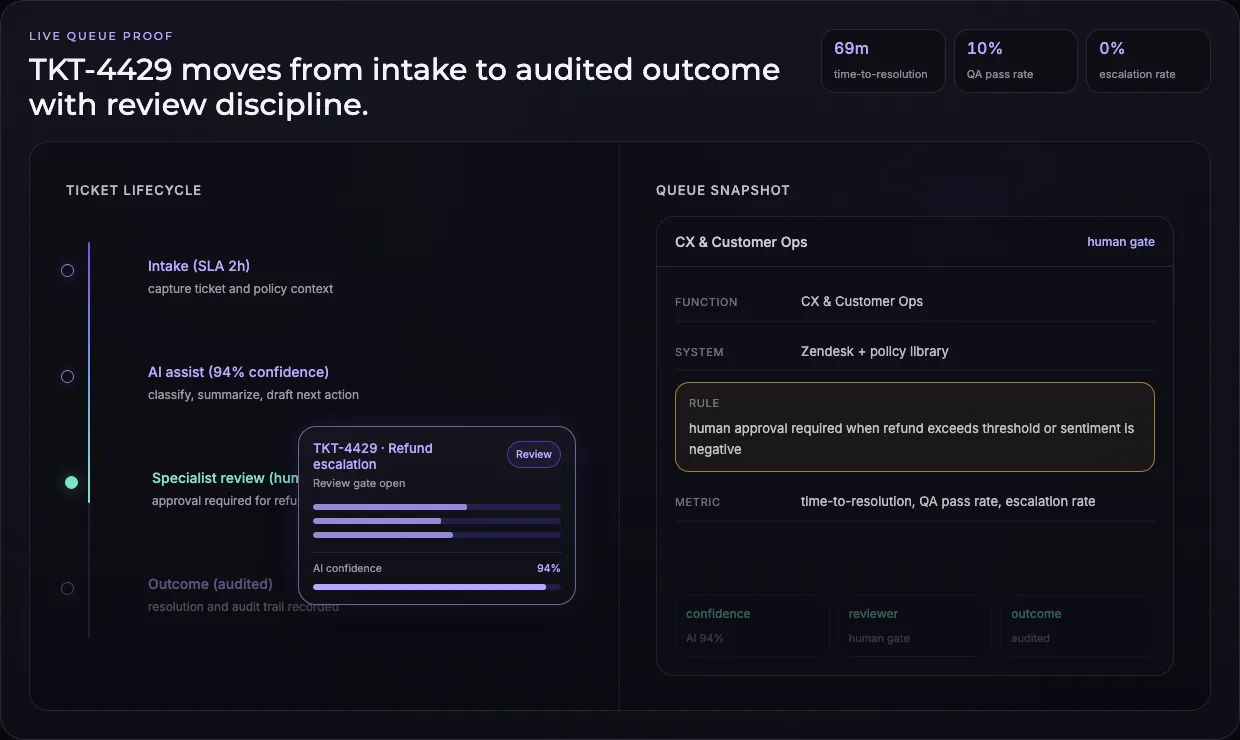
TKT-4429: refund escalation.
A refund case enters the queue, source records are attached, AI suggests the next action, human review handles the edge case, and the outcome returns with evidence for audit and reporting.
- Before: scattered notes, manual routing, unclear ownership.
- After: controlled queue, confidence-gated automation, reviewed exception, recorded outcome.
Governance
Governance is built into the workflow, not added later.
Role-based access
Work is routed by owner, reviewer, and escalation path.
Audit logs
Every automated and reviewed action keeps evidence attached.
QA sampling
Sample rules stay inside the workflow, not outside the operation.
Exception paths
Low-confidence or regulated work moves to a human before execution.
Reporting
Speed, quality, cost, control, and impact roll up weekly.
Rules framework
Automation boundaries are explicit and adjustable by workflow.
Function fit
Built for the functions where operational quality changes outcomes.
Customer Ops
Ticket triage, refunds, escalations, account updates, and service quality checks.
Finance Ops
Invoice matching, reconciliation, approvals, vendor checks, and audit support.
Sales & Marketing Ops
Lead enrichment, routing, campaign QA, CRM hygiene, and handoff control.
Next step
Bring one workflow into production discipline.
Pick a workflow with volume, exceptions, systems, and measurable outcomes. BergLabs will map the operating layer around it.
BergAuto capability benchmark
Where BergAuto sits in the enterprise automation stack.
BergAuto is the workflow automation layer inside BergLabs: visual pipelines, AI steps, transforms, conditions, database and API calls, batch runs, human wait states, and a run ledger for status, step detail, and cost. The table compares operating capability, not raw model quality.
| Capability | BergLabs BergAutoWorkflow automation layer of the Intelligent Ops Layer | Open-source orchestrationSelf-managed workflow stacks | In-house buildInternal engineering effort | Model builderFoundation-model provider consoles |
|---|---|---|---|---|
| Build & run | ||||
| Visual workflow canvas: Input, AI, Transform, Condition, Database, API, Wait, and Output steps | Native | Partial | Custom build | Limited |
| Batch spreadsheet execution with enriched, exportable rows | Native | Partial | Custom build | Limited |
| Multi-format intake: text, structured data, images, PDF, and Word documents | Native | Varies | Custom build | Model-dependent |
| Deploy & govern | ||||
| One master workflow deployed across many environments, without per-channel copies | Native | Requires assembly | Custom build | Not included |
| Human wait states, approvals, and exception handoff mid-run | Native | Requires assembly | Custom build | Limited |
| Confidence-gated routing between automation and review paths | Native | Requires assembly | Custom build | Limited |
| Operate & own | ||||
| Run ledger: status, step-level invocations, token usage, and cost per run | Native | Varies | Custom build | Provider logs |
| Operating ownership through Charterr and Quinn review paths | Native | Not included | Internal team | Not included |
Evidence note: this table compares operating-layer capabilities - how work is built, governed, and owned - based on BergAuto product documentation in the BergLabs source material. It is not a model-quality or universal outcome benchmark, and the alternative columns describe common configurations rather than any specific vendor.