


Mechanism case. This is a BergLabs measurement run on public websites, not a client engagement. The two Indian private hospital groups are printed under the pseudonyms Apollonia Hospitals (group A) and Manilla Hospitals (group M). The scan ran on 1 September 2026.
A patient who asks an AI assistant for the best hospital for heart bypass surgery rarely types a hospital chain’s name. This notebook records one way to measure whether the answer names a group anyway, and what the numbers can and cannot tell a buyer.
The question set
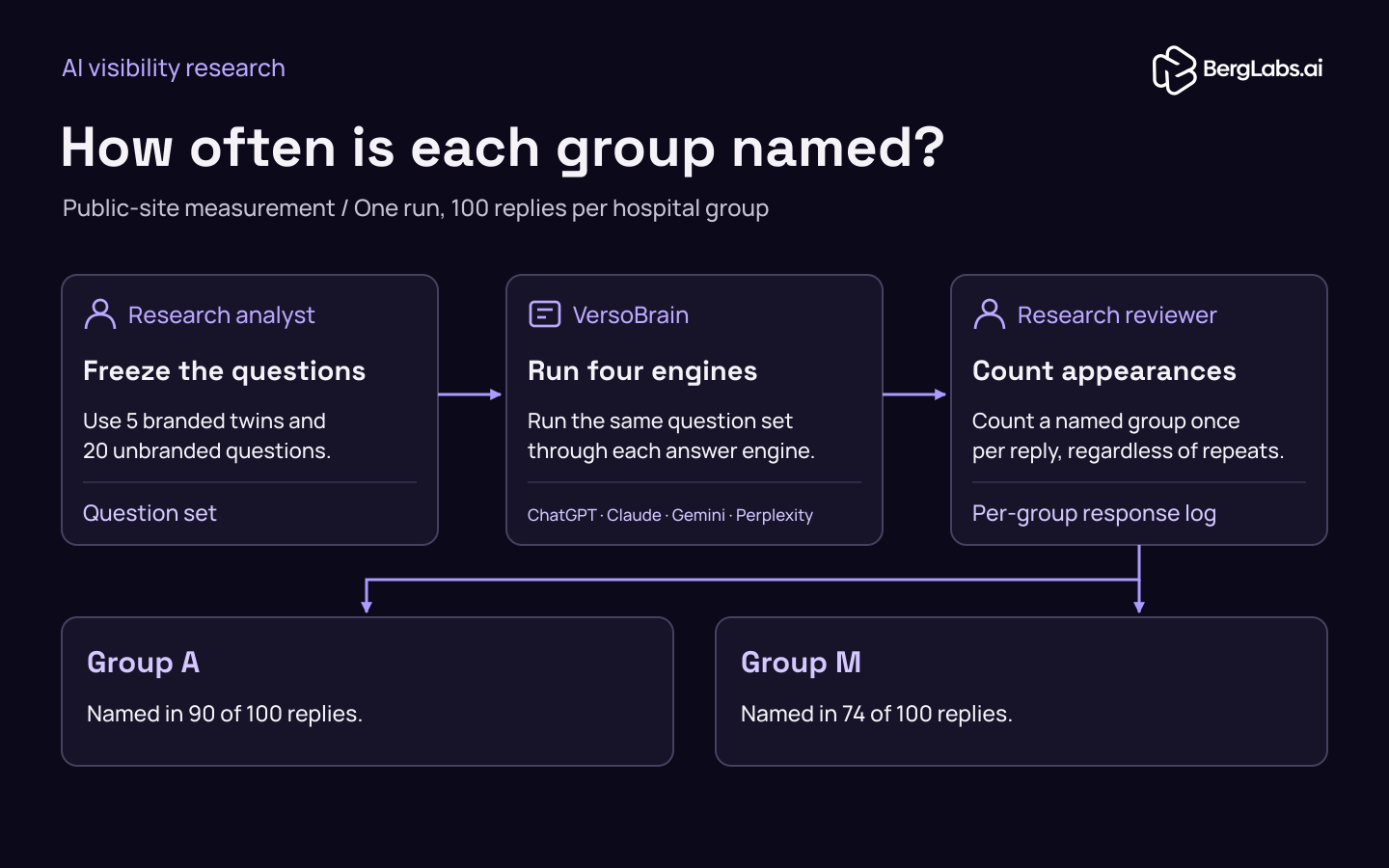
Both groups received the same 25 frozen questions, so their counts can be compared.
- 5 branded twins. The same question with only the group name swapped, such as an overview of the group, its heart-surgery care, its locations and accreditation, patient views of its cancer care and a comparison with other chains.
- 20 unbranded questions. Identical for both groups and naming neither: 12 category asks (for example best hospitals for cancer care or transplants), 3 city-level asks, 3 proof asks (such as accreditation or patient reviews) and 2 comparisons of four third-party chains.
Five prompts that would name both groups at once were left out, so one group could not inflate the other’s count.
Four engines, 100 replies per group
The questions ran through VersoBrain’s custom query path on ChatGPT, Perplexity, Claude and Gemini. Google AI Overviews is not part of that path. That gives 25 questions × 4 engines = 100 replies for each group, and every figure below uses that denominator.
What counted as an appearance
A reply counts as an appearance for a group when it names that group. Each reply counts at most once per group, however often the name appears in it. The groups are scored independently, so a single reply can count for both. That is why the two totals can add up to more than 100.
What the run recorded
| Engine | Group A · Apollonia | Group M · Manilla |
|---|---|---|
| ChatGPT | 25 of 25 | 25 of 25 |
| Perplexity | 23 of 25 | 20 of 25 |
| Claude | 22 of 25 | 14 of 25 |
| Gemini | 20 of 25 | 15 of 25 |
| All four engines | 90 of 100 | 74 of 100 |
| Sentiment (positive / neutral / negative) | 66 / 34 / 0 | 54 / 46 / 0 |
ChatGPT named both groups on every question. The gap opens on Claude and Gemini. Group M dropped to a single engine on an accreditation how-to, a city-level cancer-care question and a third-party cancer comparison that named four other chains only.
Where the citations came from
Group A’s cited sources appeared on branded and some category questions and included Wikipedia and some government and academic pages. Group M’s citations sat mostly on the branded overview question and came from its own site, one weak third-party listing and Wikipedia. Category questions rarely produced a citation for group M.
How to read the comparison
- Keep the denominator. 90 and 74 are appearances in 100 replies each, not percentages of a market.
- Do not convert appearances into outcomes. The run says nothing about market share, patient referrals, enquiries or bookings.
- It is one point in time. Engines change their sources without notice. PromptWatch, for example, reported Reddit’s share of ChatGPT Search citations falling from 3.8% to 0.5% in August 2026.
- Different questions give different scores. Two brands can only be compared on the same frozen list.
What the case did not include
The run stops at measurement. No schema, FAQ or page changes were published to either group’s site, so there is no before-and-after result. The next step in the method would be to write the missing facts onto pages that engines already cite, then ask the same 25 questions again.
