


AI search visibility becomes commercially useful when a buyer can move from a supported answer to a page that resolves their question and offers a relevant next step. Measure source correctness, page readiness and qualified action alongside brand presence. A citation alone does not prove that the page won the buyer's trust or business.
Synthetic demonstration. Zenith EV Lab is fictional. The example describes a synthetic operating scenario, with no live engine result or realised conversion outcome.
What a citation can and cannot prove
A citation proves that an engine exposed a source in one observed answer. It does not by itself prove that the source supports the claim, that the intended entity was represented correctly, or that the cited page moved a qualified buyer forward.
- Presence: did the brand appear for the fixed question?
- Support: did the cited page substantiate the answer beside it?
- Fit: did that page resolve the buyer's intent?
- Action: could the buyer take an appropriate next step?
The page still has a job to do
Zenith EV Lab is a fictional Bengaluru workshop in BergLabs' synthetic demonstration. Its modelled answers name the business, but its generic services page lacks a clear diagnostic offer and an easy booking path. The example illustrates a page-intent mismatch; it supplies no live engine observations, real customer behaviour or measured conversion loss.
The proposed fix is an evidence-backed diagnostic page: what the service covers, who it suits, verifiable equipment or technician qualifications, current price information where available, and a relevant booking action. A content owner confirms each fact, a web owner verifies the page and form, and the analyst repeats the observation protocol after the change. The demonstration does not prove that an engine will cite that page or that bookings will increase.
How SEO, AEO and GEO fit together
SEO, AEO and GEO overlap. SEO addresses discovery and usefulness across search experiences; AEO commonly describes work that helps a page answer a question; GEO commonly describes visibility and representation in generated answers. Google's generative AI search guide says its AI features rely on established Search systems. It does not require special AI markup, and Google Search ignores llms.txt for visibility and ranking.
The llms.txt project describes a proposal for helping agents use a website. That can be a separate documentation choice; it is not a citation guarantee. For ChatGPT search, OpenAI distinguishes search access from training access.
See OpenAI's publisher guidance for OAI-SearchBot access and referral tracking. Crawler access alone cannot prove that a particular answer will use a page.
An accountable answer-to-action loop
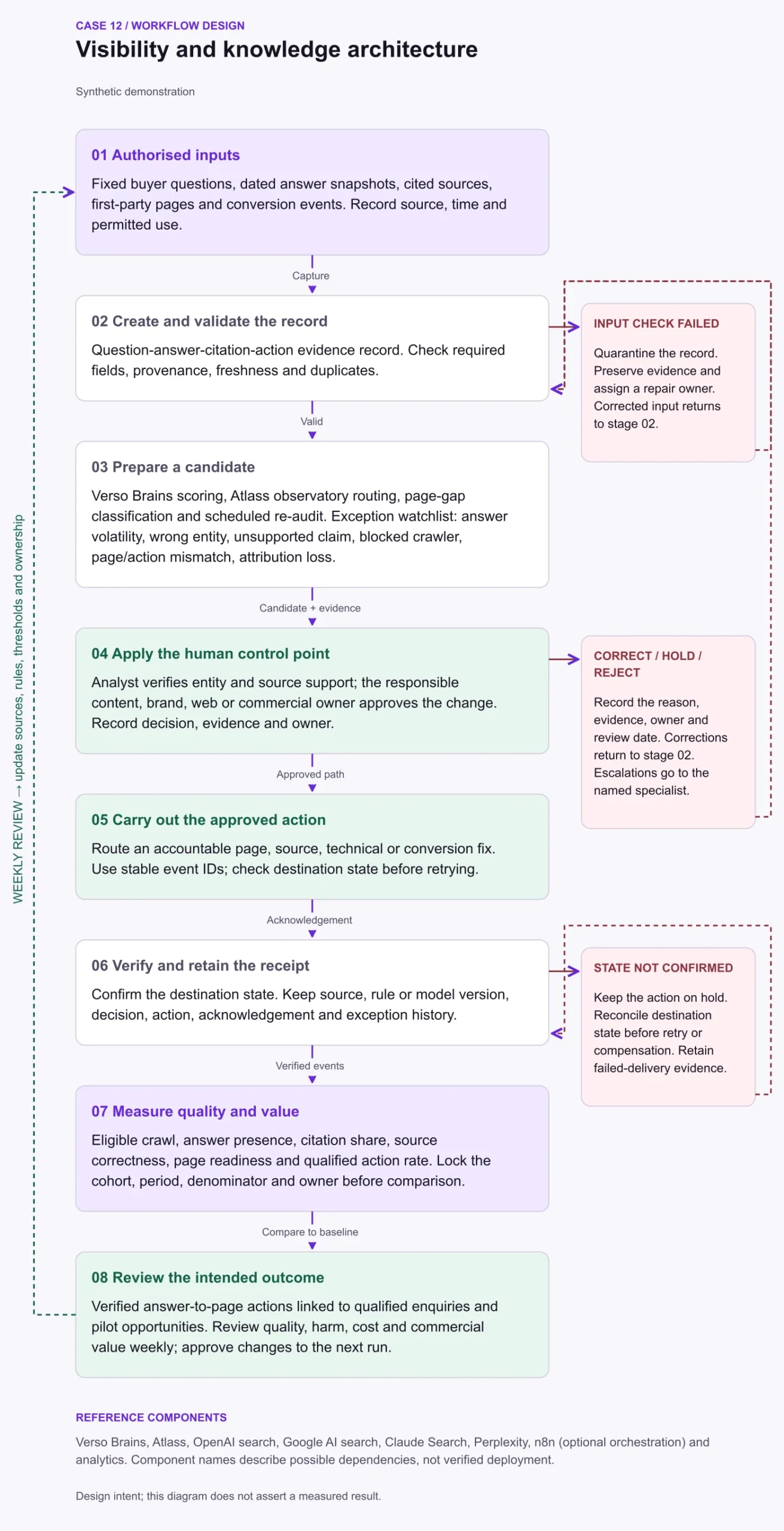
BergLabs describes Atlass as an answer-to-action observatory with VersoBrain: questions, dated answers, cited sources, intent pages, conversion actions and re-audits. In this design, diagnostic findings enter an owned queue. An authorised human confirms the evidence and approves each page, source or conversion change.
How the workflow works
Use a fixed question set and preserve dated answer snapshots, including the engine, visible product or mode, language, location and account context where available. Record whether the intended brand appears, which URLs are cited and what each cited page actually supports. Keep failed or unavailable observations visible; silently dropping them can inflate a visibility score.
Where review and controls matter
An analyst checks the entity, source support and landing-page fit, then routes the proposed change to the responsible content, brand, web or commercial owner for approval. A citation to the wrong company is an entity error. A correct citation beside an unsupported claim is an evidence error. A well-supported answer leading to an irrelevant or difficult page is a conversion problem. These require different owners and should not collapse into one unexplained score.
Risk reference: NIST AI RMF.
What to measure
Use a fixed cohort and measurement window. Count numerator events only within the denominator's eligible cohort; sampled measures use the same audit sample for both terms. Record the source, exclusions and owner, and keep missing data visible. These definitions are proposed measurement contracts, not observed results.
| Measure | Definition and unit |
|---|---|
| Crawl eligibility | In-scope URLs passing the declared access and indexability checks divided by in-scope URLs; percent. Record actual index status separately. |
| Answer presence | Valid answer observations naming the intended entity divided by valid observations for the fixed question set; percent. Report unavailable observations separately. |
| Citation share | Distinct cited URLs on the intended brand's domain divided by all distinct cited URLs within each observation, then aggregated by a declared method; percent. Report answers with no citations separately. |
| Source correctness | Audited citation-claim pairs whose source supports the associated claim and intended entity divided by audited pairs; percent. |
| Page readiness | Applicable checks passed on an intent page divided by applicable checks in a versioned rubric; percent. Show failed checks and any must-pass condition. |
| Qualified action rate | Attributed eligible sessions producing the predefined qualified action divided by attributed eligible sessions; percent. State consent coverage, identity rules and attribution window. |
AI search visibility FAQ
Does GEO replace SEO?
No. Generative search features still depend on established search systems, crawl access, useful pages and clear entities. GEO adds a disciplined way to observe generated answers, their citations and the actions those answers enable.
Does schema or llms.txt guarantee an AI citation?
No. Structured data can clarify page meaning when it matches visible content, and llms.txt may help some agents find documentation. Neither guarantees inclusion in a generated answer.
What should a first GEO pilot measure?
Use one stable question cluster and measure answer presence, citation support, landing-page readiness and a predefined qualified action. Preserve dated observations so a later change can be compared with the same protocol.
A useful first pilot
Start with one high-intent question cluster, its relevant pages and a defined qualified action. Preserve the baseline, assign each gap to an owner, verify the resulting page changes and repeat the same observation protocol. Treat changes in answer presence as observations until the sample and attribution support a stronger conclusion.
Bring the workflow, its source records and the decision that needs an owner to a BergLabs pilot discussion.
