


AI-assisted seller quality control can extract candidate attributes, flag category errors and send ambiguous listings to a reviewer. BergLabs reports approval and turnaround improvements for an anonymised seller-QC programme. The reported results need their original measurement definitions before they can be used as a benchmark.
Anonymised documented outcome. Metrics are stated on BergLabs' public case-study page as drawn from source decks; independent audit and current-period persistence are not verified here. The underlying denominator, sample design and complete measurement method are not publicly disclosed.
What the reported programme evidence shows
BergLabs' public case-study page reports a 50% increase in seller approval rates, a 9% seller-NPS uplift and an 80% reduction in QC turnaround. The source does not disclose the baselines or whether the NPS change is relative or measured in points. Those distinctions matter: the figures should be retained as reported, without converting them into a benchmark for a new workflow.
The operating problem
Seller submissions arrive with missing attributes, category errors and image-text conflicts. Manual teams waste time finding obvious defects while complex cases wait.
How the workflow works
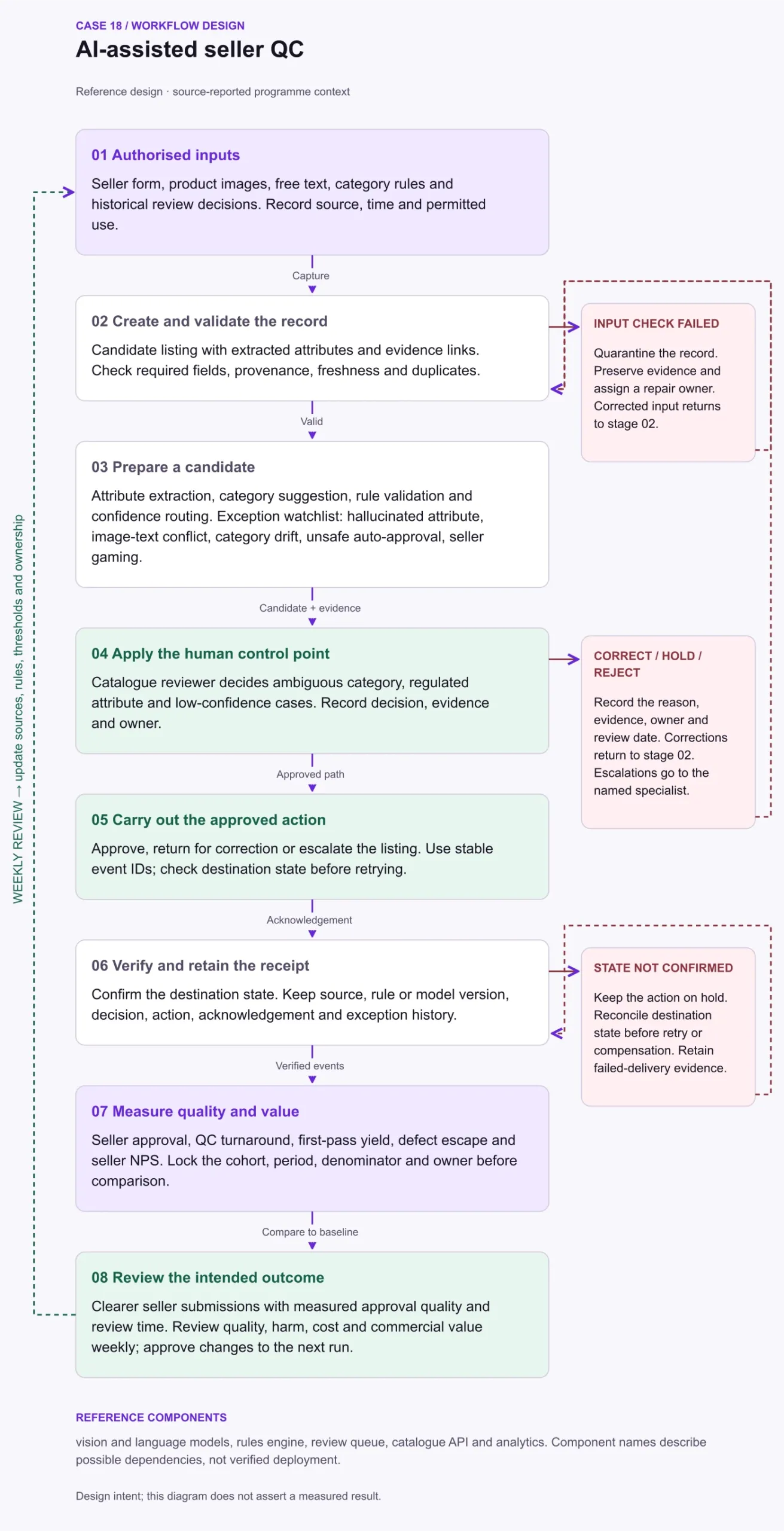
Join the seller's form, product images and category rules in one listing record. Extracted attributes remain candidates linked to their evidence. Deterministic checks can catch missing fields and inconsistent units, while model signals help prioritise image-text conflicts and uncertain categories for review.

Where review and controls matter
A reviewer confirms regulated attributes and ambiguous categories before approval. Missing evidence stays missing; the model must not invent a product feature to complete a form. Retain seller corrections and post-approval defects so the team can detect gaming, category drift and overconfident approvals. A shorter queue is useful only if approved listings continue to meet the quality standard.
Risk reference: NIST AI RMF.
What to measure
Use a fixed cohort and measurement window. Count numerator events only within the denominator's eligible cohort; sampled measures use the same audit sample for both terms. Record the source, exclusions and owner, and keep missing data visible. These definitions are proposed measurement contracts, not observed results.
| Measure | Definition and unit |
|---|---|
| Seller approval rate | Sellers approved divided by sellers completing the defined review stage; percent. State whether a change is relative or in percentage points. |
| QC turnaround | Elapsed time from review-ready submission to a final QC decision; median and p90 hours. |
| First-pass yield | Listings approved without seller rework divided by first submissions; percent. |
| Defect escape | Approved listings with confirmed QC defects divided by audited approved listings; percent. |
| Seller NPS | Percentage of promoters minus percentage of detractors among valid survey responses; NPS points. Report response rate and survey timing. |
A useful first pilot
Use one product category and a fixed intake cohort. Compare first-pass yield, review time and sampled escaped defects, with image-text conflicts included in the evaluation set.
Bring the workflow, its source records and the decision that needs an owner to a BergLabs pilot discussion.
