


Payment reconciliation automation works best when deterministic rules handle clear matches and finance reviewers own ambiguous exceptions. A control tower should preserve the settlement, ledger and refund evidence behind every decision, then confirm the destination state before treating a correction as complete.
What is payment reconciliation automation?
Payment reconciliation automation compares processor, settlement and ledger evidence to close clear matches and route exceptions for controlled human review. A reliable workflow preserves the reason for every match, hold and correction, then verifies the destination state before closing the case.
The operating problem
Daily settlement files, processor webhooks and ledger entries disagree in timing, identifiers and status semantics. A naive matcher either leaves too many exceptions or silently joins the wrong transactions.
How BergLabs runs the exception loop
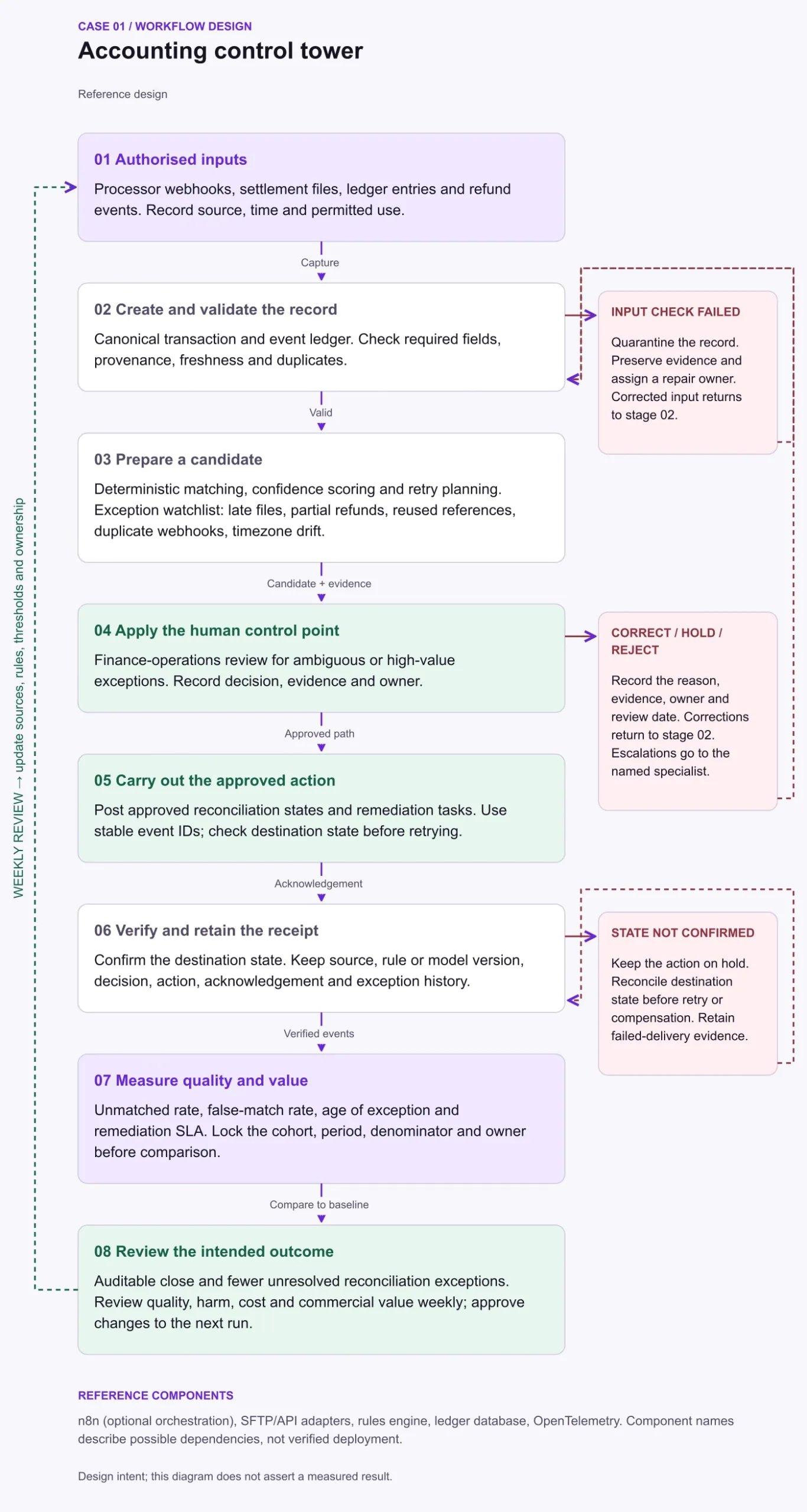
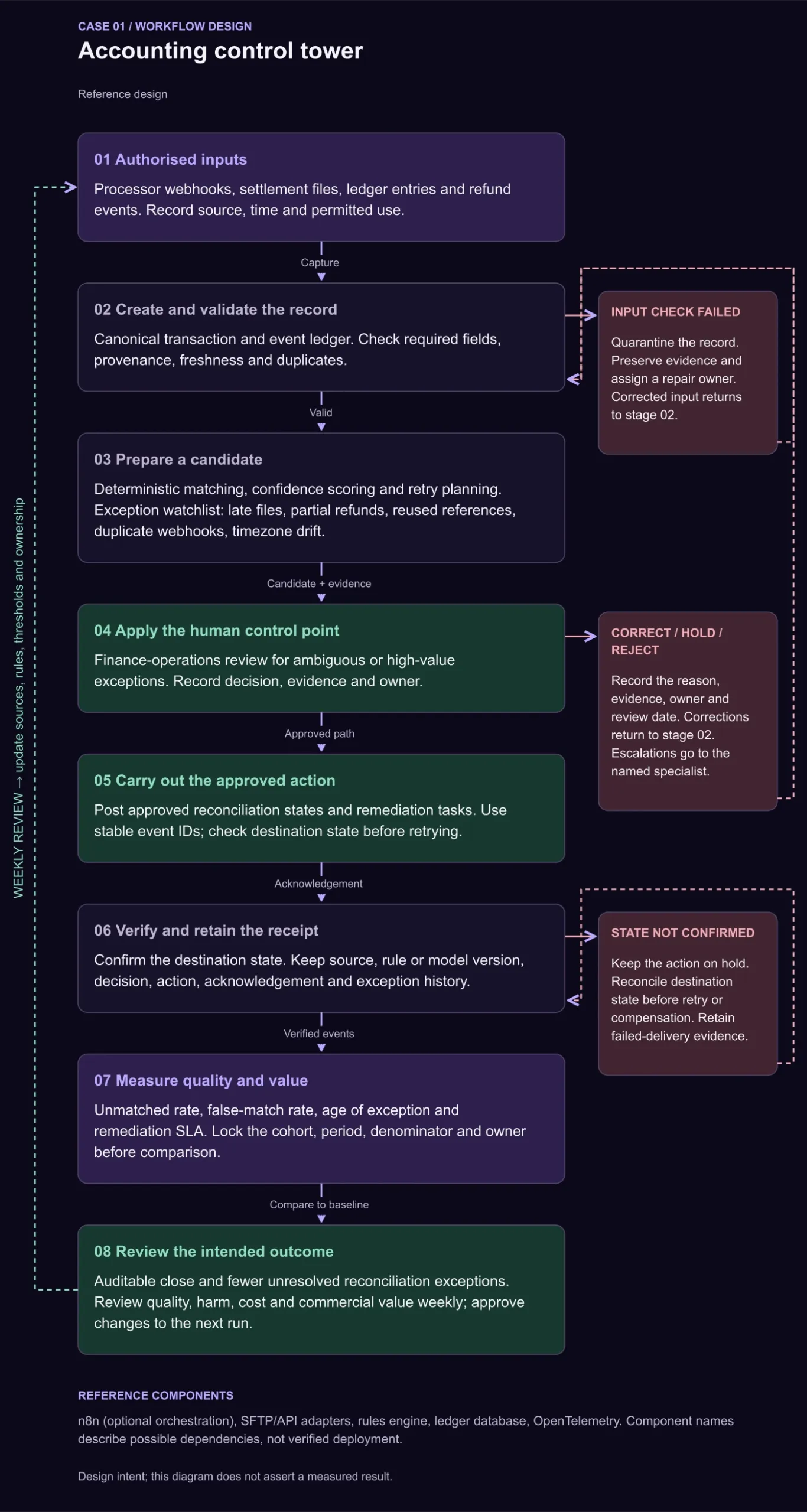
In our in-house reference pattern, BergAuto ingests events, applies deterministic matching rules and opens exceptions. BergFlow preserves the settlement, ledger and refund evidence with the rule outcome, reviewer decision and verified correction.
Rosterr assigns exceptions and tracks their review state; Quinn supports specialist vetting where finance expertise is required; and Charterr supports a managed reconciliation pod. This is an implementation pattern, not a claim that the exact configuration or outcome has been deployed for a named client.
How the workflow works
Build one transaction record from processor events, settlement files and ledger entries. Keep event time separate from arrival time, and preserve partial refunds as their own events. A match needs an agreed combination of identifiers, currency, amount and status; a reused reference alone is weak evidence. Confidence can prioritise review, but it cannot repair missing source facts.
Where review and controls matter
Late files stay pending until the settlement window closes. A reviewer sees both sides of an ambiguous match, the failed rule and any prior remediation. Approved corrections carry a stable action ID. If a request times out, the team checks the ledger before trying again; otherwise one exception can create two corrections. Timezone rules belong in the matching contract, where they can be tested.
Retry reference: Stripe idempotent requests. Destination support and reconciliation still need verification.
What to measure
Use a fixed cohort and measurement window. Count numerator events only within the denominator's eligible cohort; sampled measures use the same audit sample for both terms. Record the source, exclusions and owner, and keep missing data visible. These definitions are proposed measurement contracts, not observed results.
| Measure | Definition and unit |
|---|---|
| Unmatched rate | Unmatched eligible settlement items divided by all eligible items after the declared settlement window; percent. |
| False-match rate | Incorrect matches divided by audited matches; percent. Report the audit sampling method. |
| Exception age | Time from exception creation to the reporting cutoff for open items; median and p90 hours. Report resolved-item cycle time separately. |
| Remediation SLA | Exceptions resolved within their agreed deadline divided by exceptions due in the period; percent. |
Payment reconciliation automation FAQ
What can be automated in payment reconciliation?
Clear, deterministic matches can be automated when the identifiers, currency, amount, status and settlement window meet an agreed rule. Missing or conflicting source facts should not be guessed.
When is human review required?
Route ambiguous joins, late files, reused references, partial refunds, duplicate events and corrections with material financial impact to an authorised reviewer.
How do you avoid duplicate corrections?
Give each approved action a stable identifier, make supported requests idempotent, and check the destination ledger state before retrying or closing the exception.
A useful first pilot
Choose one processor, one ledger and a closed settlement period. Replay known unmatched items, partial refunds and duplicate webhooks. The first useful pilot result is a reconciled exception queue with an owner and evidence for every decision.
Bring the workflow, its source records and the decision that needs an owner to a BergLabs pilot discussion.
