


A financial-data contributor workflow should accept evidence-backed, usable records before it creates a payable event. Quality acceptance and payment release are separate decisions: the first checks the contribution, while the second checks the payee, amount and authorised payout state.
Composite reference architecture. A modelled case; no contributor volume, payout or accuracy outcome is claimed. Worker classification, tax, payout-provider and jurisdictional obligations require separate legal review.
The operating problem
A submission is not valuable merely because it arrived. The operator must verify identity, provenance, duplication, schema compliance and quality before accepting the record and triggering money movement.
How the workflow works
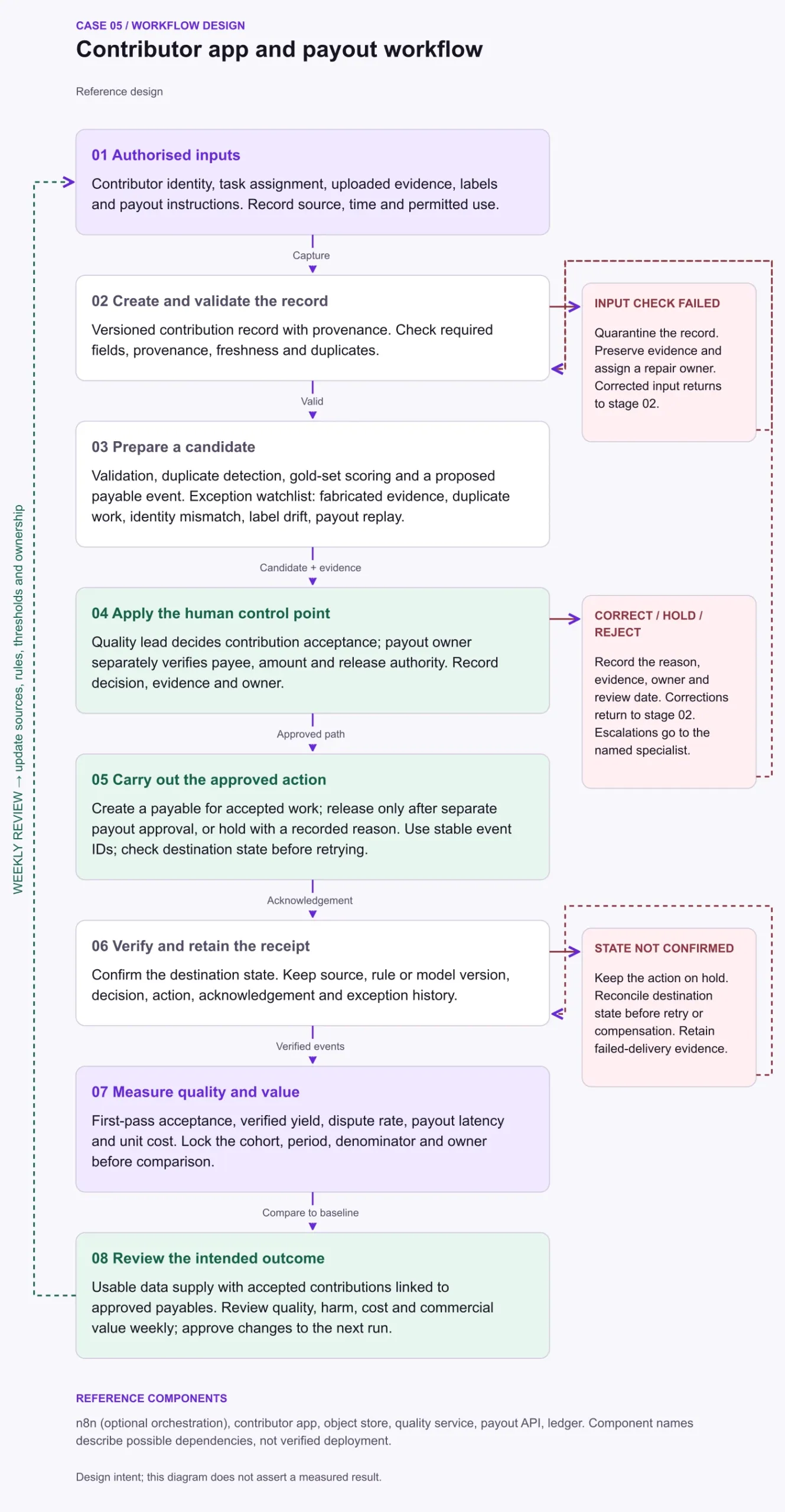
Give each assignment and submission a stable ID. Preserve the uploaded evidence, schema version and contributor provenance beside the extracted fields or labels. Check duplicates and score applicable tasks against a protected gold set. A quality lead can accept, return or reject the contribution with a reason the contributor can understand.
Where review and controls matter
Fabricated evidence and identity conflicts require review, even when the fields look valid. Accepted work creates a payable candidate under the agreed terms; it does not itself move money. A payout owner verifies the payee and amount, handles disputes and reconciles the destination state before retrying an uncertain release. Worker classification, tax and payout obligations depend on the operating jurisdiction and need their own authorised review.
Retry reference: Stripe idempotent requests. Destination support and reconciliation still need verification.
What to measure
Use a fixed cohort and measurement window. Count numerator events only within the denominator's eligible cohort; sampled measures use the same audit sample for both terms. Record the source, exclusions and owner, and keep missing data visible. These definitions are proposed measurement contracts, not observed results.
| Measure | Definition and unit |
|---|---|
| First-pass acceptance | Contributions accepted without a correction cycle divided by first submissions; percent. |
| Verified yield | Accepted contributions meeting the final verification standard divided by eligible submitted contributions; percent. |
| Dispute rate | Contributions with a formal quality or payout dispute divided by completed contributions; percent, split by dispute type. |
| Payout latency | Time from approved payable status to confirmed payout completion; median and p90 hours or days. |
| Unit cost | All attributable acquisition, contributor compensation, review and payout-processing cost divided by accepted usable contributions; currency per contribution. |
A useful first pilot
Use a fixed task type and a test payout ledger. Trace submitted evidence through acceptance, a correction cycle and a disputed payout. Confirm that replaying an accepted contribution cannot create another payable obligation.
Bring the workflow, its source records and the decision that needs an owner to a BergLabs pilot discussion.
