


A field-service diagnostic copilot should identify the equipment version, retrieve the applicable manual and propose the next approved test with its source. Qualified technicians retain repair authority. Missing context, low confidence and safety-critical work need an explicit escalation path.
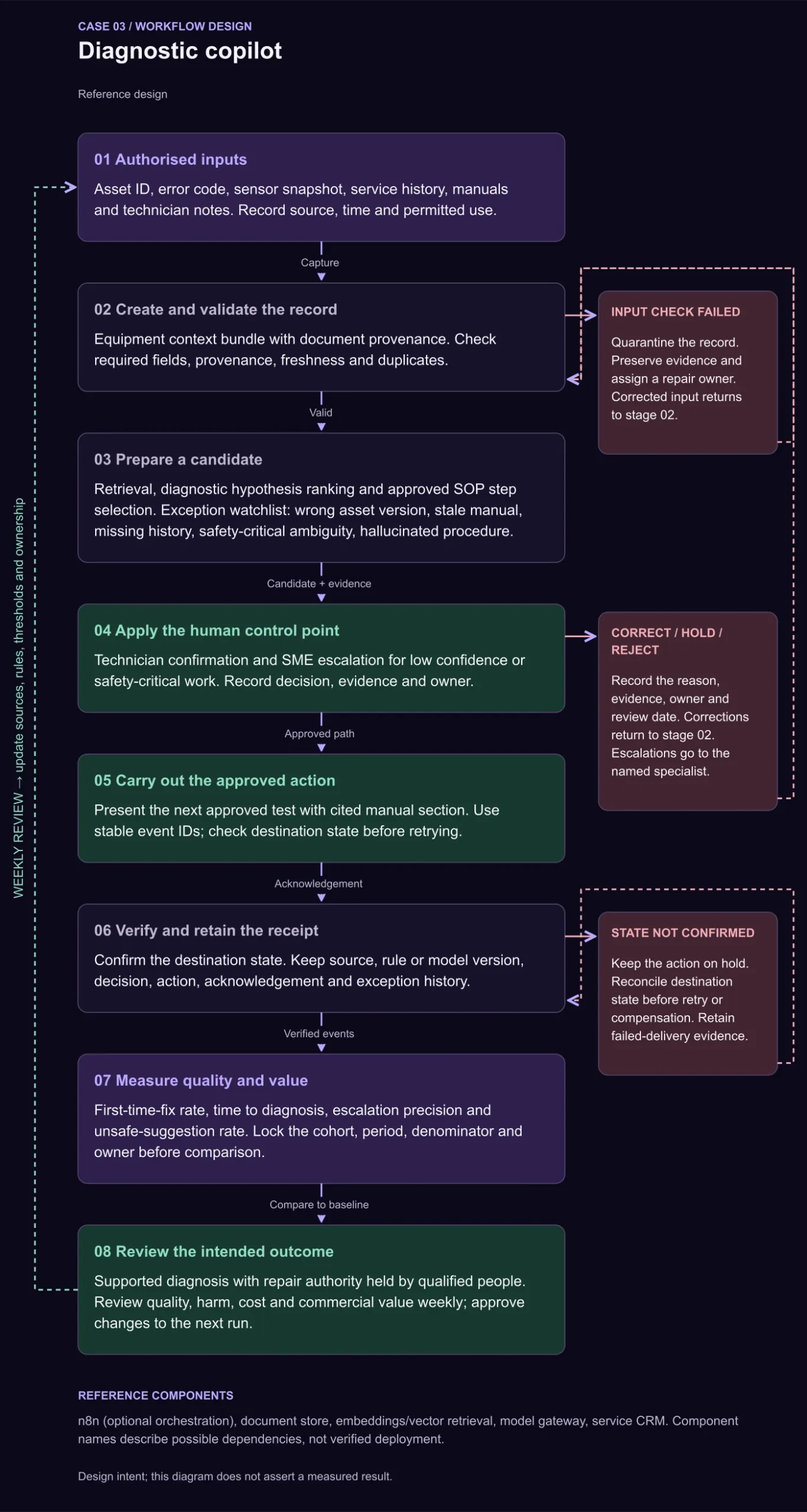
Composite reference architecture. A modelled field-service reference architecture; no project-specific source, production deployment or outcome metric is asserted.
The operating problem
Technicians work across manuals, service histories and error codes while customers wait. A fluent answer is dangerous if the model skips an approved diagnostic step or loses the equipment context.
How the workflow works
Join the asset ID, error code, sensor snapshot and service history before retrieving instructions. Store the manual version and section beside each proposed test. Diagnostic hypotheses can help order the investigation, but the technician needs the evidence and prerequisites for the next step, including when the equipment must be taken out of service under its approved procedure.

Where review and controls matter
An absent or stale manual should stop procedural guidance for that asset version. Contradictory sensor readings and incomplete history stay visible rather than being filled in by generated text. Safety-critical ambiguity moves to a qualified subject-matter expert. Record the technician's confirmation, test result and eventual repair so later evaluation can distinguish a useful suggestion from a plausible but wrong answer.
Risk reference: NIST AI RMF.
What to measure
Use a fixed cohort and measurement window. Count numerator events only within the denominator's eligible cohort; sampled measures use the same audit sample for both terms. Record the source, exclusions and owner, and keep missing data visible. These definitions are proposed measurement contracts, not observed results.
| Measure | Definition and unit |
|---|---|
| First-time-fix rate | Jobs resolved without a repeat visit for the same fault within a fixed follow-up window divided by eligible completed jobs whose full follow-up window has elapsed; percent. |
| Time to diagnosis | Elapsed time from diagnostic intake to a technician-confirmed diagnosis; median and p90 minutes. |
| Escalation precision | Escalations judged necessary by an expert divided by audited escalations; percent. Also audit non-escalated cases for missed risks. |
| Unsafe-suggestion rate | Proposed steps judged unsafe under the applicable procedure divided by audited proposed steps; percent. |
A useful first pilot
Replay a bounded set of service cases against the exact approved manuals. Include wrong-version documents and incomplete histories. Have qualified reviewers assess the proposed next step before any field use.
Bring the workflow, its source records and the decision that needs an owner to a BergLabs pilot discussion.
