


Published client result. The figures on this page come from BergLabs’ 2026 annotation delivery deck for an anonymised large manual annotation programme. They are source-reported and have not been re-measured here. The same programme is featured as Case 19; this page is the operating review of its routing decision.
The decision that changed this programme was simple to state and hard to get right: which labels does a person need to see? Before the change, every item went to a person. After it, a calibrated confidence score chose the route, and quality assurance sampled both routes.
Before: every label went to a person
The programme was fully manual, with about 1,000 annotators. Labour and infrastructure costs grew with volume, accuracy varied between teams, and manual throughput could not absorb spikes in incoming data, so deliveries slipped. Removing people from the loop was not an option either: an unreviewed model output can introduce inconsistent labels and silent errors.
The decision: a confidence gate with a direction
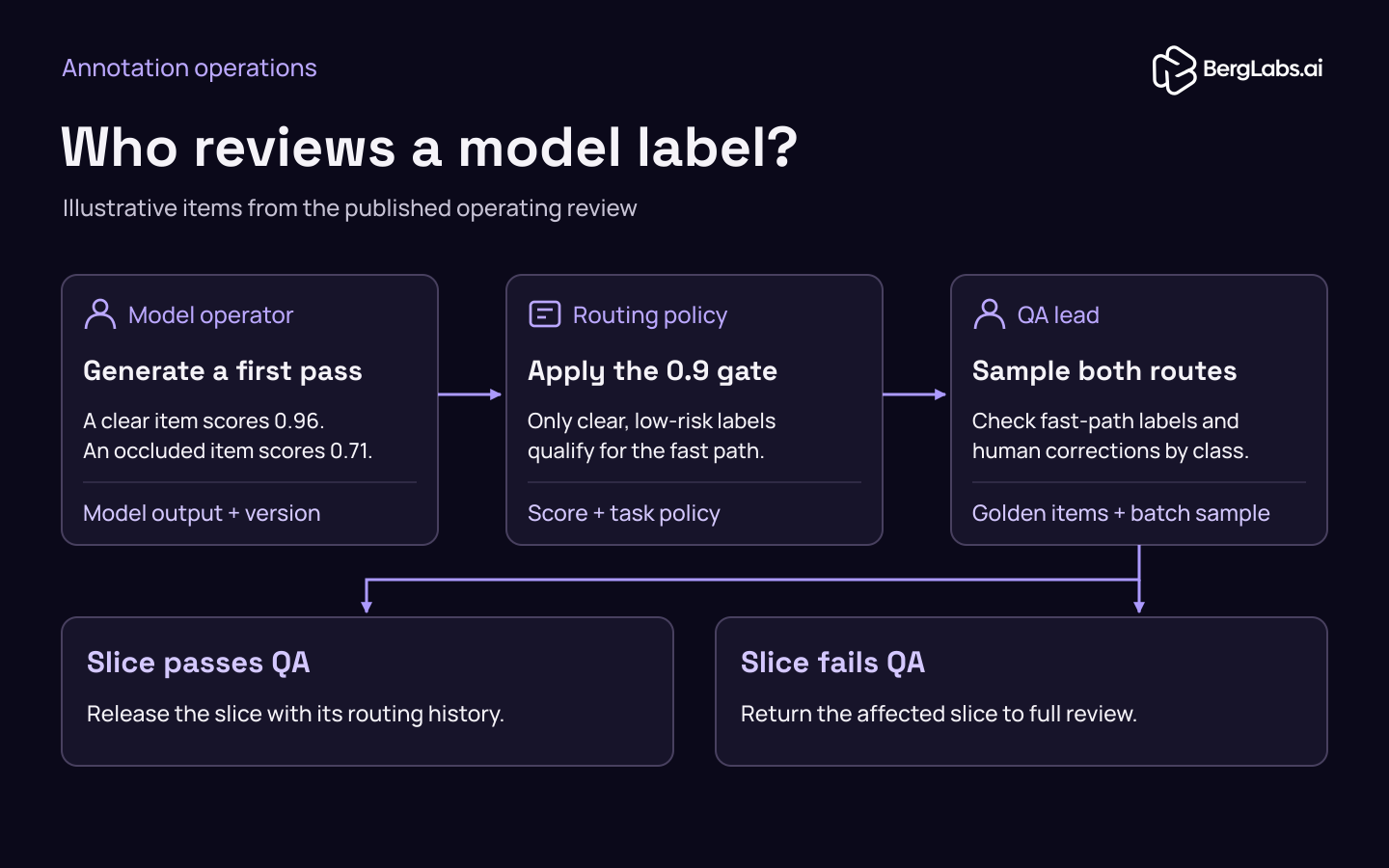
BergLabs rebuilt the work as a hybrid pipeline. AI first-pass processing labels each item and attaches a confidence score. The task policy then sets the route:
- At or above 0.9, on clear and low-risk segments: the label continues on the fast path without a routine human pass.
- Below 0.9, or flagged by the task policy: the item goes to a reviewer, who confirms, corrects or rejects the suggestion.
The direction matters. A higher score means less routine review, never no review. A 0.9 score is a routing setting, not a promise of 90% accuracy; it has to be checked against observed correctness for each task and class.
Two items through the gate
Illustrative items, not client records.
| Step | Item A: single-product photo | Item B: multi-item photo |
|---|---|---|
| Model suggestion | Category: electric kettle | Attribute: material, stainless steel |
| Confidence | 0.96, low-risk class | 0.71, two objects overlap |
| Route | Fast path | Reviewer queue |
| Human decision | None by default; eligible for the QA sample | Reviewer corrects the material and records the cause: occlusion |
| What is kept | Suggestion, score, route and model version | Suggestion, score, correction, cause, reviewer and final label |
The model suggestion and the accepted label stay separate in the record. Item B’s correction joins the improvement set, so the next model version sees the case it got wrong.
How QA samples the batch
Fast-path items are sampled independently, because a high score is exactly where silent errors hide. Reviewed items are sampled too, to check the reviewers. Golden items with known answers run through both routes. If a slice of the batch fails its quality check, that slice returns to full review, and automation coverage grows only for slices that pass. Verified corrections feed back into the model to improve precision and future coverage.
After: the reported results
| Measure | Reported result | Definition in the source |
|---|---|---|
| Turnaround | 30% faster | Annotation time reduced from 100 hours to 70 hours |
| Cost | 15% savings per project | Attributed to fewer manual touchpoints |
| Accuracy | 96% | Review accuracy, held consistently at scale |
The source does not publish the sample, measurement period or full method behind these figures, so read them as one programme’s reported outcome rather than a benchmark for any 0.9 threshold.
What a buyer should take from it
The useful question is not “what threshold should we use?” but “what evidence lets us lower review on this class without losing accuracy?” Start with a fully reviewed reference sample, calibrate the threshold by class, keep a fast-path audit sample for the life of the programme and let corrections reach the accepted record.
