


SKU benchmarking needs dated, comparable product observations before it can support a market conclusion. Match the exact variant, pack size, seller, market and availability state, then have an analyst verify material conclusions against the captured source evidence.
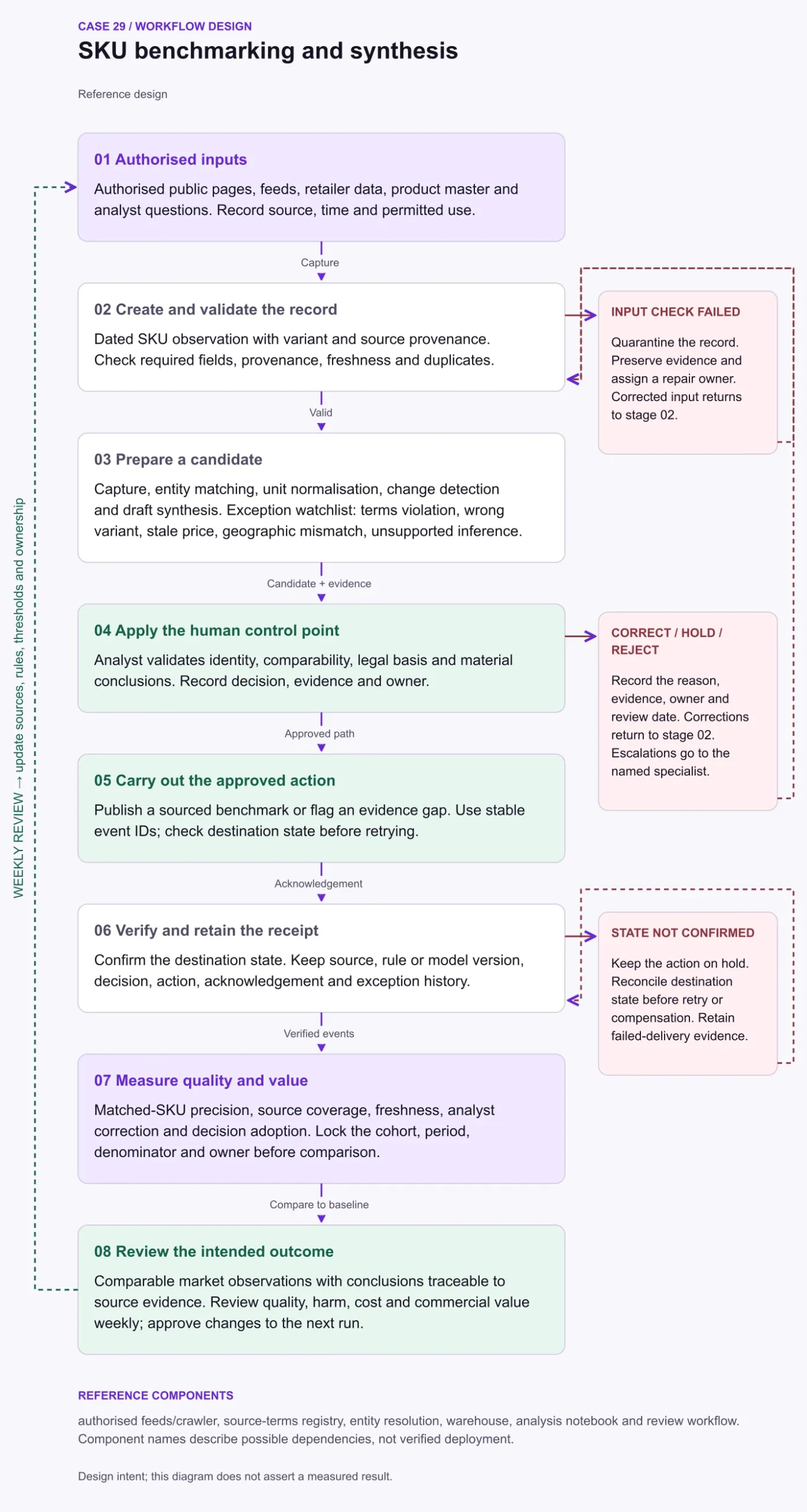
Composite reference architecture. A modelled intelligence workflow; no competitor dataset, commercial decision or market outcome is claimed.
The operating problem
Prices, pack sizes, availability and claims change by market, seller and date. A summary without capture evidence can compare different variants and present a temporary promotion as strategy.
How the workflow works
Capture only authorised pages or feeds under their permitted terms. Store the product identifier, variant, currency, pack size, seller and observation time with the displayed price and conditions. Normalise units only where the products remain meaningfully comparable. Draft synthesis should point back to these observations so an analyst can inspect the basis of a claimed difference.

Where review and controls matter
A promotional price, unavailable listing or different geography can invalidate an apparent comparison. Retain coupon and delivery conditions rather than converting them into an assumed universal price. Uncertain entity matches stay unconfirmed. Analysts should label inferences as inferences and leave missing evidence visible instead of generating a confident market narrative.
Risk reference: NIST AI RMF.
What to measure
Use a fixed cohort and measurement window. Count numerator events only within the denominator's eligible cohort; sampled measures use the same audit sample for both terms. Record the source, exclusions and owner, and keep missing data visible. These definitions are proposed measurement contracts, not observed results.
| Measure | Definition and unit |
|---|---|
| Matched-SKU precision | Confirmed correct variant matches divided by audited proposed matches; percent. |
| Source coverage | Required SKU-source observations successfully captured divided by planned observations; percent. |
| Freshness | Elapsed time since source capture at the reporting cutoff; median and p90 hours or days. |
| Analyst correction | Material fields or conclusions corrected by the analyst divided by audited fields or conclusions; percent, reported separately. |
| Decision adoption | Benchmark recommendations explicitly used in a recorded decision divided by recommendations delivered for decision; percent. Adoption alone does not prove commercial benefit. |
A useful first pilot
Choose a narrow SKU family, one geography and a fixed observation window. Review entity matching and unit normalisation manually, then check whether the resulting benchmark answers a specific pricing or assortment decision.
Bring the workflow, its source records and the decision that needs an owner to a BergLabs pilot discussion.
