


Seller onboarding should finish with a verified readiness state, rather than a completed form. Identity, business evidence, payment-related fields and category-specific listing requirements need independent checks, with an authorised reviewer approving activation or recording what remains unresolved.
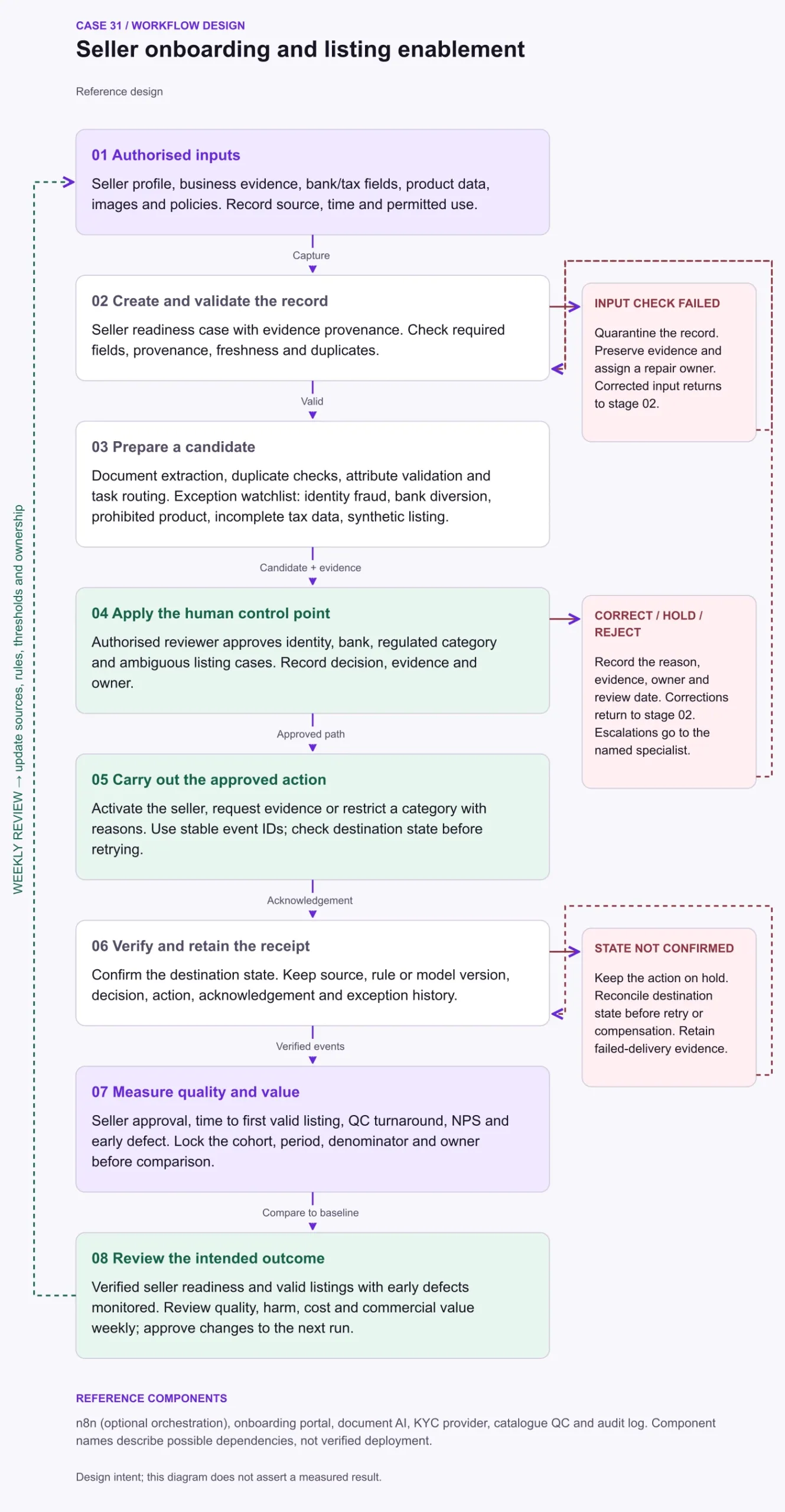
Composite reference architecture. A composite seller-readiness workflow. The public BergLabs source supports a related seller-QC programme; it does not document the identity, KYC, bank-verification or activation design shown here.
Evidence boundary
A related seller-QC programme appears in BergLabs' case studies. That source supports the broader programme context. It does not establish a deployment or measured result for the specific reference design described here.
The operating problem
A seller can finish the form while identity, bank, tax, category and listing evidence remain inconsistent. Readiness must be an explicit state with owners and expiry rules.
How the workflow works
Build a seller case that tracks evidence provenance, required checks and expiry. Prepare candidate fields through document extraction and route missing information to the correct owner. Keep seller-level readiness separate from listing-level approval: an approved business can still submit an invalid product, and a well-formed listing cannot establish the seller's identity.
Where review and controls matter
Identity conflicts, bank changes and regulated categories need authorised review under the applicable policy. The workflow should request evidence or restrict the affected category with a reason instead of creating a false-ready state. After activation, early listing defects feed back into the readiness checks. A related catalogue-QC programme does not establish that this exact identity or activation workflow was deployed.
Risk reference: NIST AI RMF.
What to measure
Use a fixed cohort and measurement window. Count numerator events only within the denominator's eligible cohort; sampled measures use the same audit sample for both terms. Record the source, exclusions and owner, and keep missing data visible. These definitions are proposed measurement contracts, not observed results.
| Measure | Definition and unit |
|---|---|
| Seller approval | Sellers receiving final authorised approval divided by sellers completing the defined review stage; percent. |
| Time to first valid listing | Time from complete seller intake to the first approved, usable listing; median and p90 days. |
| QC turnaround | Time from review-ready listing submission to final QC decision; median and p90 hours. |
| Seller NPS | Promoter percentage minus detractor percentage among valid seller survey responses; NPS points, with response rate. |
| Early defect | Activated sellers with a confirmed onboarding or listing defect within a fixed early window divided by audited activated sellers with complete follow-up; percent, split by defect type. |
A useful first pilot
Follow a small seller cohort through one product category, including a corrected identity field, a bank-change request and an invalid first listing. Verify activation and listing approval as separate destination states.
Bring the workflow, its source records and the decision that needs an owner to a BergLabs pilot discussion.
