


Multimodal marketplace quality control should evaluate the media and the destination together. Image, sampled video, extracted text and landing-page evidence need one case record, with contextual review for uncertain or consequential enforcement decisions.
Composite reference architecture. A modelled quality-and-safety architecture; no client relationship, accuracy or moderation outcome is asserted.
The operating problem
Image, video and landing-page checks operate on different assets and policies. A clean thumbnail can lead to a prohibited page; a conservative model can also suppress legitimate products.
How the workflow works
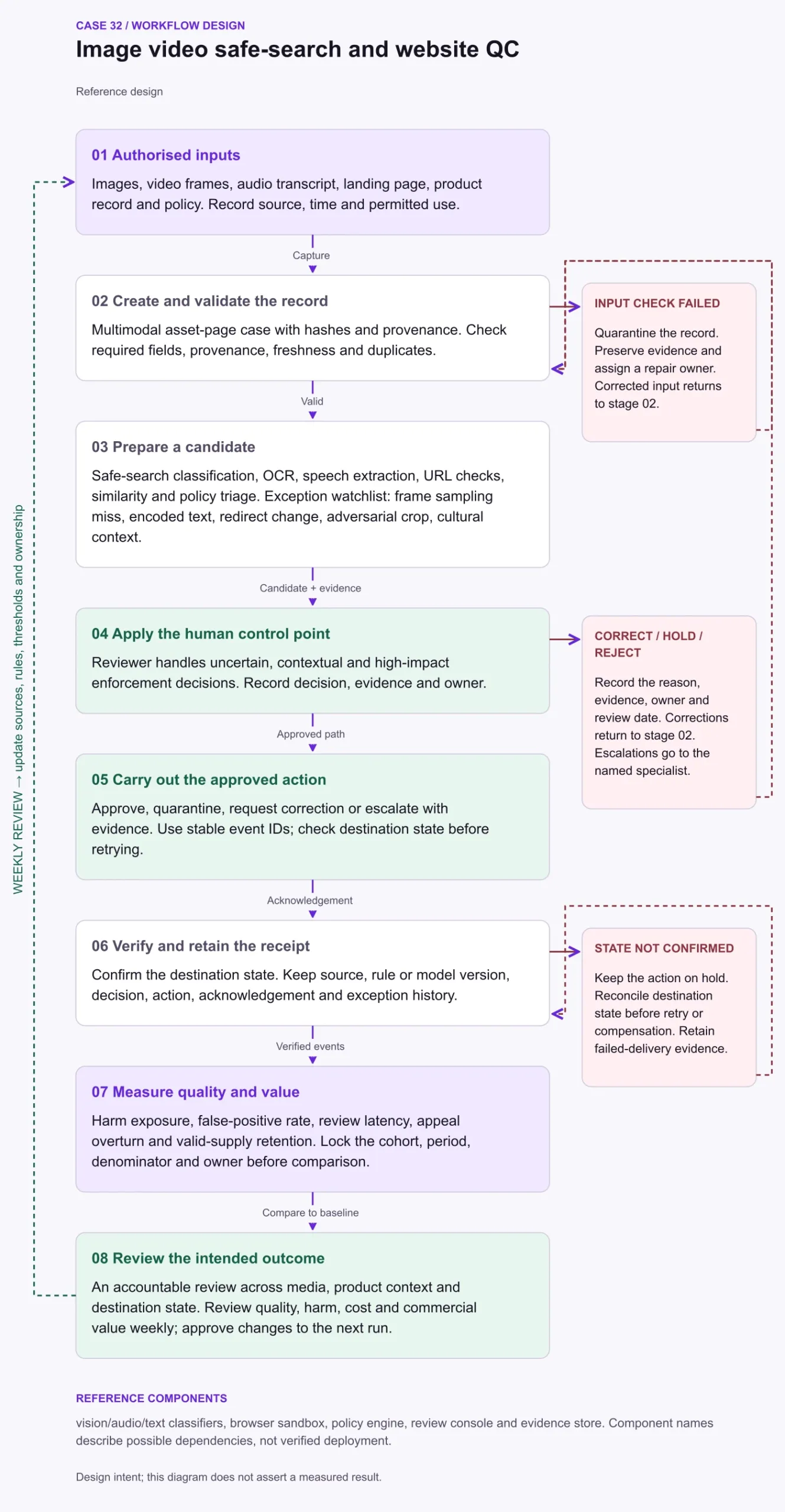
Link the product record to its images, video frames, transcript and destination URL. Preserve asset hashes and the capture time of the landing page, including the observed redirect destination. Classifiers and rule checks prepare candidate findings across these surfaces. A clean thumbnail does not establish that the video or linked page meets the same policy.
Where review and controls matter
Video sampling can miss brief harmful frames, and redirects can change after approval. Test the sampling strategy against known failure cases and recheck destination evidence when the policy requires it. Encoded text, adversarial crops and cultural context need an explicit review route. Keep false positives visible so aggressive filtering does not silently remove valid supply.
Risk reference: NIST AI RMF.
What to measure
Use a fixed cohort and measurement window. Count numerator events only within the denominator's eligible cohort; sampled measures use the same audit sample for both terms. Record the source, exclusions and owner, and keep missing data visible. These definitions are proposed measurement contracts, not observed results.
| Measure | Definition and unit |
|---|---|
| Harm exposure | Impressions of confirmed violating media or destinations within the audited cohort divided by all eligible impressions in that same cohort; rate per declared unit, split by surface. State sampling weights for any population estimate. |
| False-positive rate | Compliant cases incorrectly flagged or blocked divided by audited compliant cases; percent. |
| Review latency | Time from case creation to the required quality decision; median and p90 minutes, by risk class. |
| Appeal overturn | Appealed decisions changed after review divided by decided appeals; percent. |
| Valid-supply retention | Confirmed compliant listings remaining available after review divided by confirmed compliant listings reviewed; percent. |
A useful first pilot
Evaluate a bounded media-and-page cohort containing changed redirects, brief video violations and unusual legitimate imagery. Verify that each decision cites the affected surface and that appeals can reconstruct the original evidence.
Bring the workflow, its source records and the decision that needs an owner to a BergLabs pilot discussion.
