


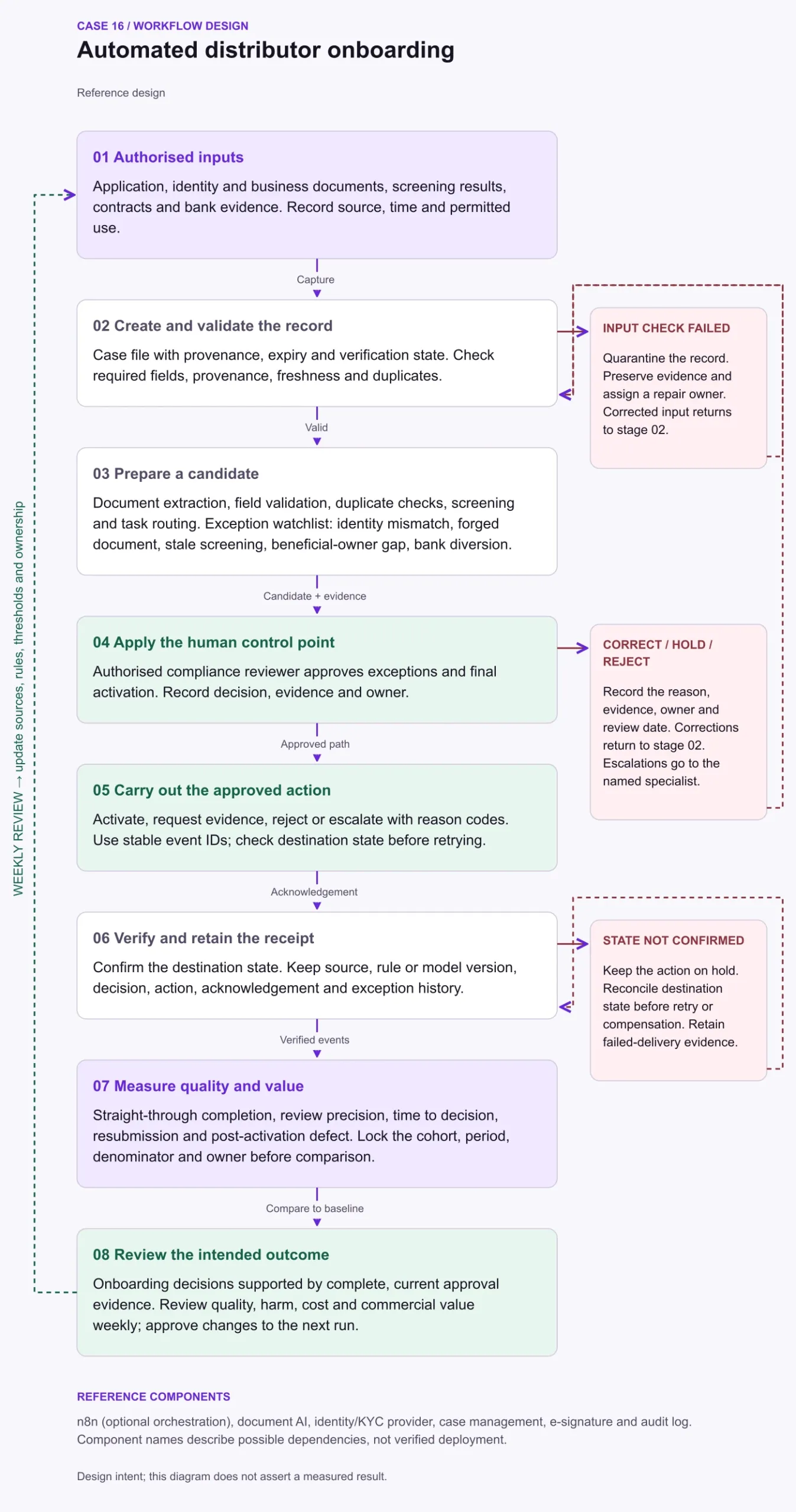
Distributor onboarding automation should assemble an evidence-complete case and prepare checks, while an authorised compliance reviewer owns activation and exceptions. Document extraction is one step: identity, ownership, screening, contracts and payment-related evidence must agree under the applicable onboarding policy.
Composite reference architecture. A reference design; it is not legal advice and does not claim a live KYC programme.
The operating problem
Onboarding combines identity, business registration, beneficial ownership, sanctions checks, contracts, bank verification and territory rules. Missing one dependency creates a false-ready distributor.
How the workflow works
Assign a case ID and track every required document or verification with its source, expiry and state. Extraction can populate candidate fields, and validation can identify gaps or conflicts. Screening results must be tied to the intended entity and the time of the check. The readiness state should show which dependencies remain unresolved.

Where review and controls matter
Possible forgery, beneficial-owner gaps and identity mismatches need specialist review. Bank changes require independent verification through the approved channel. Stale screening must be refreshed before the final decision where the policy requires it. Record the authorised activation, rejection or evidence request with a reason; this design does not prescribe a jurisdiction's KYC obligations or certify compliance.
Risk reference: NIST AI RMF.
What to measure
Use a fixed cohort and measurement window. Count numerator events only within the denominator's eligible cohort; sampled measures use the same audit sample for both terms. Record the source, exclusions and owner, and keep missing data visible. These definitions are proposed measurement contracts, not observed results.
| Measure | Definition and unit |
|---|---|
| Straight-through completion | Cases reaching an evidence-complete review state without manual data repair divided by eligible submitted cases; percent. Final activation authority remains separate. |
| Review precision | Flagged exceptions judged valid by an authorised reviewer divided by reviewed flags; percent. |
| Time to decision | Time from complete required application to final authorised decision; median and p90 days. Report applicant waiting time separately. |
| Resubmission | Applications requiring another evidence submission divided by applications reviewed; percent. |
| Post-activation defect | Audited activated cases with a confirmed onboarding defect during the fixed follow-up window divided by audited activated cases whose full window has elapsed; percent. |
A useful first pilot
Replay a bounded set of onboarding cases under one approved policy. Include expiring documents, similar entity names and changed bank details. Verify that no unresolved required check can produce an activation state.
Bring the workflow, its source records and the decision that needs an owner to a BergLabs pilot discussion.
