


An AI-data workforce marketplace should connect recruitment sources to verified, project-ready capacity. Applicant volume becomes useful only after identity, language, task skill and availability checks show that the worker can meet a specific production requirement.
Composite reference architecture. A modelled architecture derived from the BergLabs case taxonomy; hiring volumes and conversion outcomes are not claimed.
The operating problem
Top-of-funnel applicant counts obscure the real constraint: role-specific, language-specific and shift-specific capacity that passes identity, skill and policy checks.
How the workflow works
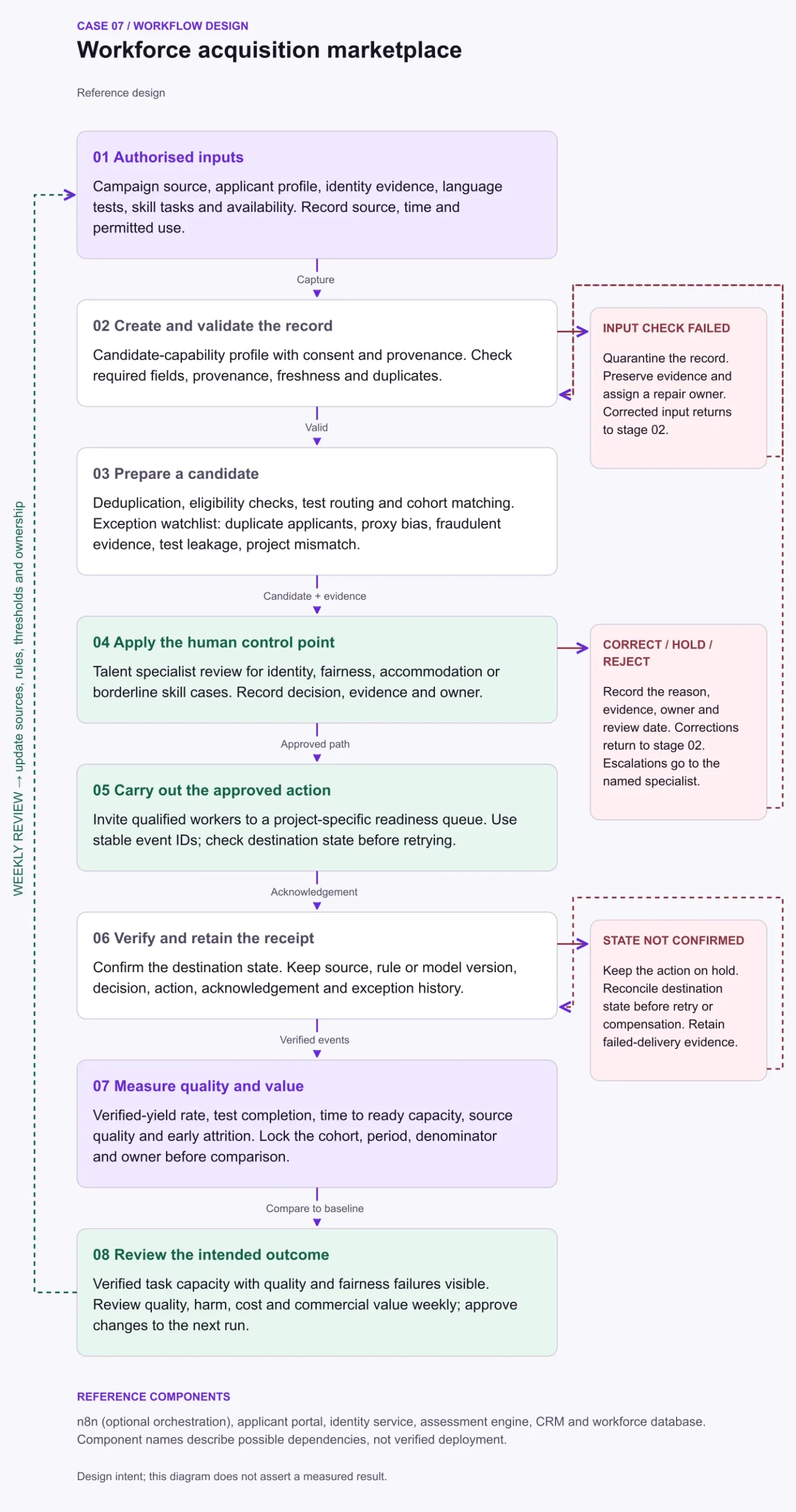
Track each applicant from campaign source to assessment and project readiness without duplicating profiles. Role-specific tasks should test the work the person would perform. Keep language, domain skill, shift availability and assessment expiry as separate fields so an overall score cannot hide a critical gap.

Where review and controls matter
Identity conflicts, possible test leakage and borderline assessments go to a talent specialist. Accommodations and fairness review need an explicit route; protected traits or weak proxies should not become unexamined ranking features. A qualified worker enters the readiness queue for a matched project, then early production quality provides feedback on whether the assessment was useful.
Risk reference: NIST AI RMF.
What to measure
Use a fixed cohort and measurement window. Count numerator events only within the denominator's eligible cohort; sampled measures use the same audit sample for both terms. Record the source, exclusions and owner, and keep missing data visible. These definitions are proposed measurement contracts, not observed results.
| Measure | Definition and unit |
|---|---|
| Verified-yield rate | Applicants meeting all project-readiness checks divided by eligible applicants in the intake cohort; percent. |
| Test completion | Applicants completing assigned assessments by their deadline divided by applicants whose assigned assessments were due in the measurement window; percent. |
| Time to ready capacity | Elapsed time from approved demand to the required verified capacity becoming available; days. Also report applicant-level readiness time. |
| Source quality | Project-ready workers from each recruitment source divided by eligible applicants from that source; percent. |
| Early attrition | Activated workers leaving within a fixed early-tenure window divided by activated workers with a complete window; percent. |
A useful first pilot
Select one language, task family and shift requirement. Follow the full cohort through assessment and early production, including applicants who do not complete the process, to identify the actual capacity constraint.
Bring the workflow, its source records and the decision that needs an owner to a BergLabs pilot discussion.
