


AI customer operations should preserve the customer's identity, context and case state across channels, then verify whether the issue was resolved. Human agents need a clear handoff for disputes, vulnerability, uncertain policy use and consequential changes.
Composite reference architecture. A modelled architecture; no service-level or satisfaction improvement is represented as realised.
The operating problem
Bots often optimise containment while customers repeat context, policies drift and unresolved cases disappear between channels.
How the workflow works
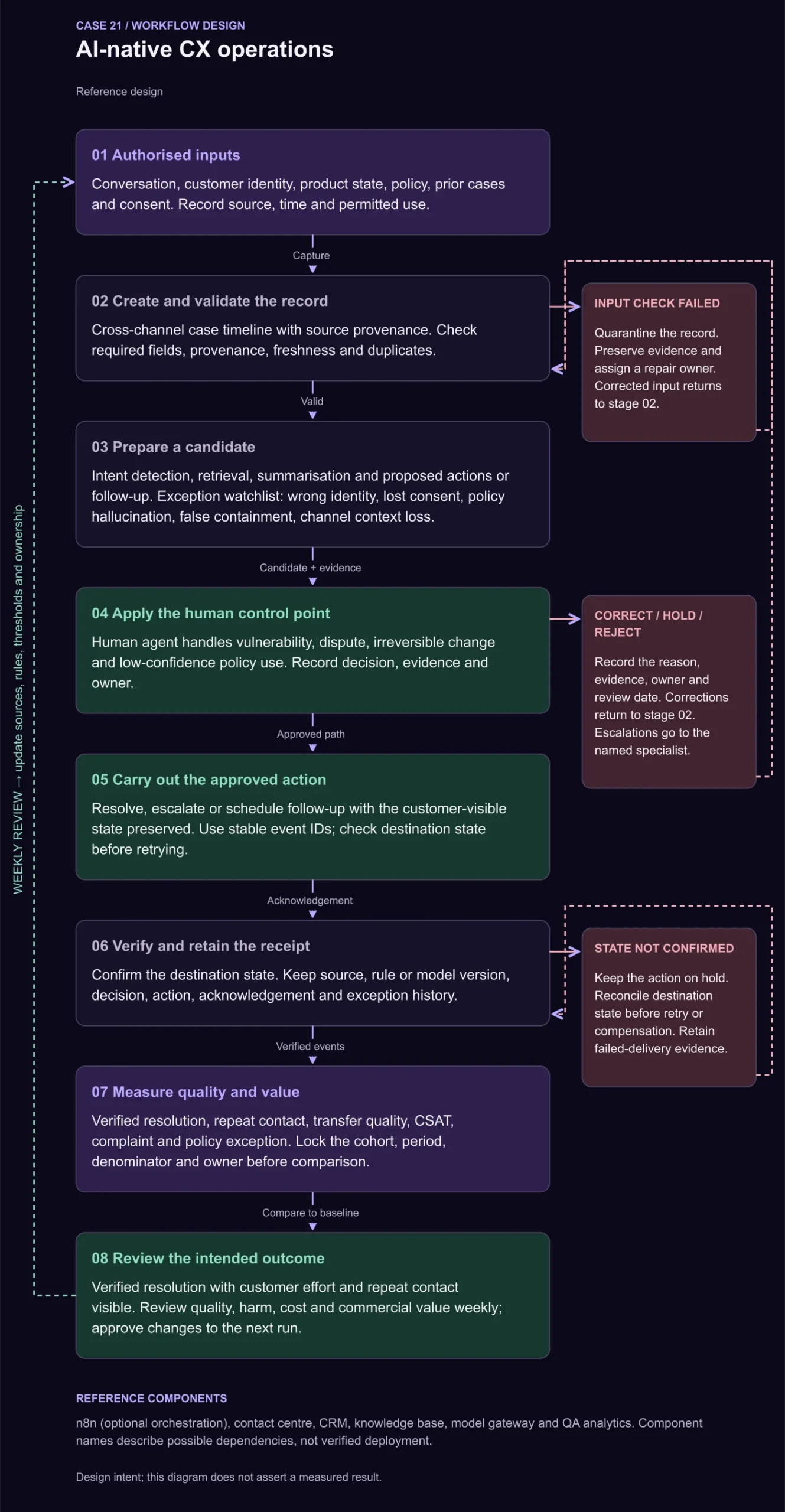
Build a case timeline from authorised conversations, product state and prior interactions. Retrieval should return the policy version relevant to the issue. Automation can prepare a summary and an allowed next action, while the receiving agent sees what has been attempted and what remains unresolved. The customer-visible state should remain consistent when the channel changes.

Where review and controls matter
Wrong-account context and lost consent should stop the affected action. A generated policy explanation must be checked against its source. Closing a conversation or avoiding a transfer does not establish resolution. Preserve the reason for a handoff and confirm the destination state after any approved action, then watch for repeat contact or reopening within the defined follow-up window.
Risk reference: NIST AI RMF.
What to measure
Use a fixed cohort and measurement window. Count numerator events only within the denominator's eligible cohort; sampled measures use the same audit sample for both terms. Record the source, exclusions and owner, and keep missing data visible. These definitions are proposed measurement contracts, not observed results.
| Measure | Definition and unit |
|---|---|
| Verified resolution | Cases meeting the issue-specific resolution check with no same-issue reopening during a fixed follow-up window divided by eligible cases with full follow-up; percent. |
| Repeat contact | Cases with another contact for the same issue inside the fixed follow-up window divided by eligible cases whose full window has elapsed; percent. |
| Transfer quality | Audited handoffs containing the required context and accepted by the receiving team divided by audited handoffs; percent. |
| CSAT | Positive responses divided by valid responses under the declared survey scale; percent, with response rate. |
| Complaint rate | Cases producing a formal service complaint divided by eligible cases; percent. |
| Policy exception rate | Cases requiring an authorised policy exception divided by eligible cases; percent, with outcome and reason. |
A useful first pilot
Follow one issue type across two channels, including a transfer and a repeat contact. Compare the recorded resolution with customer and destination-system evidence before optimising handling effort.
Bring the workflow, its source records and the decision that needs an owner to a BergLabs pilot discussion.
