


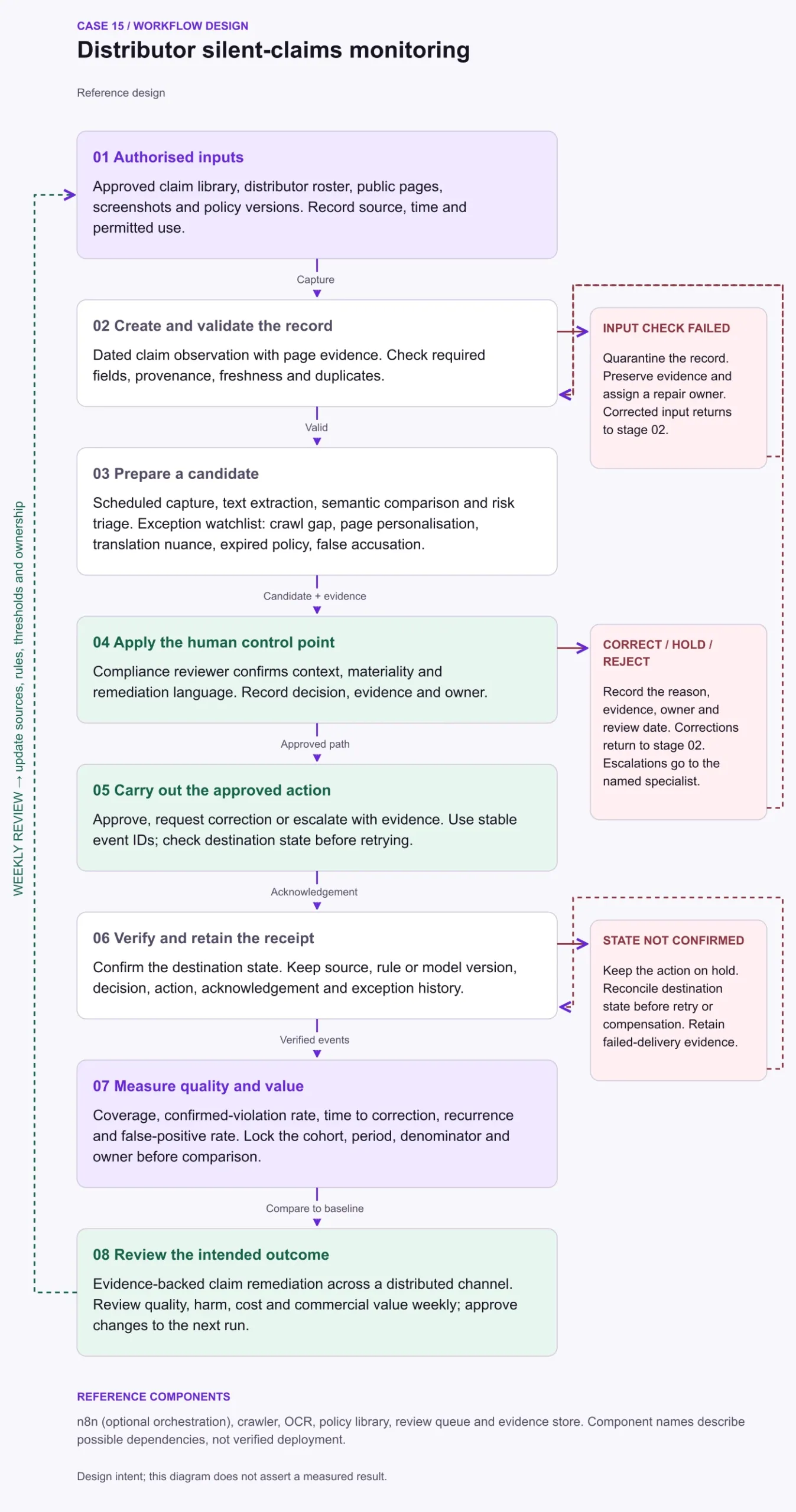
Distributor claims monitoring should capture dated page evidence, compare it with an approved claim library and route possible violations to compliance review. A model can flag a changed meaning; an authorised reviewer must verify context and materiality before requesting correction or escalating.
Composite reference architecture. A modelled monitoring workflow; no enforcement programme or risk reduction is claimed.
The operating problem
Distributors change web pages, listings and social copy faster than central compliance teams can review them. The risk is not merely a forbidden phrase; it is a claim whose meaning changes in context.
How the workflow works
Maintain the distributor roster, permitted sources and current policy version. For each observation, retain the page URL, capture time and relevant text or screenshot. Compare the claim in context, including qualifications and translated wording. Schedule coverage by channel so an unvisited page is reported as a coverage gap rather than implicitly treated as compliant.
Where review and controls matter
Personalised pages, expired policies and translation ambiguity can create false accusations. Reviewers need the observed wording beside the approved wording and the reason for the flag. After an authorised correction request, verify the changed page and keep the original evidence. Recurring claims feed back into distributor guidance and the review rules.
Risk reference: NIST AI RMF.
What to measure
Use a fixed cohort and measurement window. Count numerator events only within the denominator's eligible cohort; sampled measures use the same audit sample for both terms. Record the source, exclusions and owner, and keep missing data visible. These definitions are proposed measurement contracts, not observed results.
| Measure | Definition and unit |
|---|---|
| Coverage | In-scope distributor-channel pages successfully observed during the period divided by pages scheduled for observation; percent. |
| Confirmed-violation rate | Flagged observations confirmed as violations divided by reviewed flags; percent. This measures flag precision, not overall violation prevalence. |
| Time to correction | Elapsed time from confirmed violation to verified corrected page; median and p90 days. |
| Recurrence | Corrected distributor-claim cases that recur within a fixed follow-up window divided by corrected cases with complete follow-up; percent. |
| False-positive rate | Compliant observations incorrectly flagged divided by audited compliant observations; percent, using a sample that includes unflagged content. |
A useful first pilot
Monitor a bounded distributor set and an approved claim library. Have compliance adjudicate flagged and unflagged samples, then follow confirmed cases through a verified correction. Applicable legal rules must come from the responsible compliance owner.
Bring the workflow, its source records and the decision that needs an owner to a BergLabs pilot discussion.
