


A collections voice workflow can transcribe an authorised conversation, identify a proposed payment promise and prepare permitted follow-up. A reviewer must confirm material amounts and dates, and handle hardship, disputes and policy exceptions before the system records or acts on the promise.
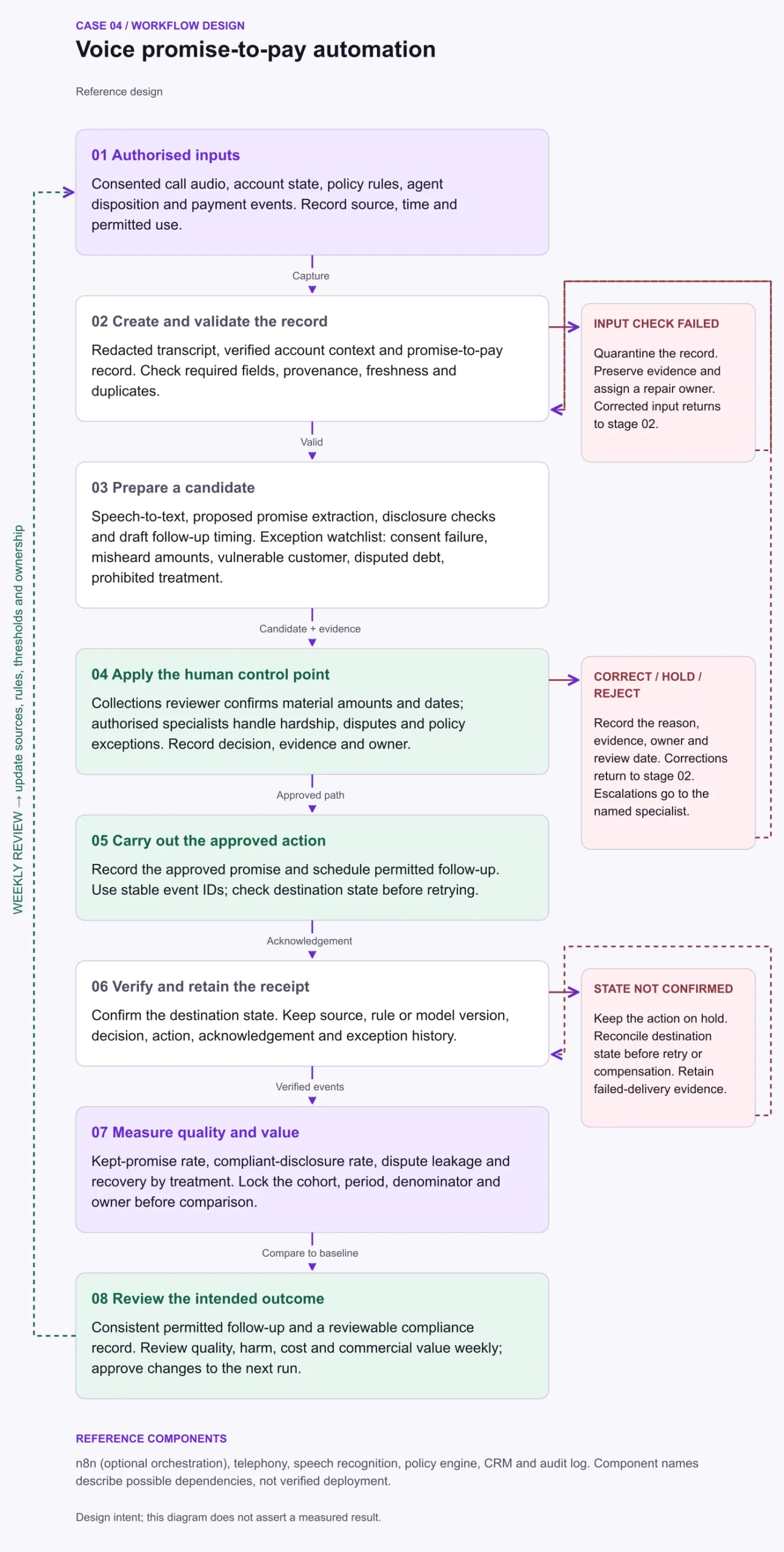
Composite reference architecture. A modelled design, not evidence of a live collections deployment or realised recovery rate.
What is a promise-to-pay workflow?
A promise-to-pay workflow links an authorised customer conversation to a verified amount, date, policy decision and permitted follow-up. Speech recognition can prepare the evidence, but the commitment is not authoritative until identity, material terms and exceptions have passed the required controls.
The operating problem
Collection calls mix identity verification, hardship signals, disclosures, payment promises and follow-up actions. Summarising the call is useful; deciding eligibility or coercive next action without policy checks is not.
How BergLabs runs the voice workflow
In our in-house reference pattern, BergAuto orchestrates call-to-case processing, policy checks and permitted follow-up gates. BergFlow links the relevant audio segment, transcript, proposed promise, policy version, reviewer decision and final action in one controlled record.
Rosterr routes disputes, hardship signals and ambiguous commitments; Quinn supports vetting for authorised collections and compliance reviewers; and Charterr supports a managed operations pod. This is a BergLabs reference design, not evidence of a live deployment or realised recovery rate.
How the workflow works
Keep account verification separate from speech recognition. The case record should link the relevant audio segment to the extracted amount, due date and agent disposition, with access and retention controls appropriate to the intended use. Compare the proposed follow-up against the approved treatment policy for that account and jurisdiction.
Humanising the call is an operating control, not a tone setting: let the caller interrupt, correct a detail or explain hardship without restarting the flow, preserve the latest turn, and keep response latency within a declared budget. That keeps the exchange responsive while the amount, date and policy decision remain traceable.
Where review and controls matter
A misheard amount cannot become a customer commitment. Unclear dates, disputed debt and vulnerability signals go to an authorised collections or compliance reviewer with the original evidence. The workflow records the decision and schedules only the permitted treatment. Consent, disclosures, contact restrictions and treatment rules must be supplied by the responsible legal and compliance owners; this reference design does not establish those rules.
Risk reference: NIST AI RMF.
What to measure
Use a fixed cohort and measurement window. Count numerator events only within the denominator's eligible cohort; sampled measures use the same audit sample for both terms. Record the source, exclusions and owner, and keep missing data visible. These definitions are proposed measurement contracts, not observed results.
| Measure | Definition and unit |
|---|---|
| Kept-promise rate | Promises fully met by the agreed due date and grace rule divided by promises whose observation window has closed; percent. |
| Compliant-disclosure rate | Audited calls meeting the applicable disclosure checklist divided by audited calls requiring those disclosures; percent. |
| Dispute leakage | Cases with a confirmed dispute that incorrectly continued routine collection treatment divided by cases with confirmed disputes; percent. |
| Recovery by treatment | Amount recovered divided by eligible opening balance for each treatment cohort; percent. Cohort differences and causal attribution require separate analysis. |
Collections voice workflow FAQ
Can AI record a promise to pay automatically?
AI can transcribe and propose the amount, date and follow-up. It should not make the promise authoritative when identity, material terms, policy eligibility or consent remain unverified.
What must go to human review?
Route disputes, hardship or vulnerability signals, unclear amounts or dates, failed identity checks and policy exceptions to an authorised reviewer with the original audio evidence.
How should a voice workflow be measured?
Measure extraction accuracy and permitted treatment separately. Then track kept-promise rate, compliant disclosures, dispute leakage and recovery by treatment on declared cohorts and observation windows.
A useful first pilot
Evaluate historical, lawfully usable calls under a locked policy version. Include misheard numbers, disputed balances and hardship language. Review both extraction accuracy and whether the proposed follow-up was permitted.
Bring the workflow, its source records and the decision that needs an owner to a BergLabs pilot discussion.
