


To improve AI-search visibility, check whether relevant buyer questions produce an accurate mention or citation, then inspect the page and action that follow. Preserve dated evidence, fix the specific gap and repeat the same measurement protocol. Search access, clear content and useful pages improve the conditions for discovery; they cannot guarantee a generated recommendation.
Evidence note. The Zenith EV Lab example below is fictional and uses analyst-assigned demonstration scores from 31 August 2026. It is not a live search audit, a client result or a measured conversion outcome. Product descriptions and search guidance are linked beside the claims they support.
SEO, AEO and GEO overlap
A buyer can search for your brand, ask for alternatives or describe a problem without knowing who solves it. The useful distinction is the question and the observed answer. The labels help organise the work, but they should not create competing teams or duplicate pages.
| Term | What the work addresses | Evidence to inspect |
|---|---|---|
| SEO | Discovery, relevance and usefulness across search experiences. | Accessible pages, indexed URLs, search performance and useful visits. |
| AEO | How clearly a page answers a question and supports the answer. | The visible answer, its factual sources and its fit with the reader's question. |
| GEO | How a brand or source appears in generated answers. | Dated answers, correct entity mentions, citations and the page reached. |
Google's generative AI search guide treats optimisation for its AI features as SEO. It says Google Search ignores llms.txt for ranking and visibility and requires no special AI markup. Clear writing and semantic structure help readers; there is no required AI-only writing format.
Google also states that AI-feature eligibility depends on established Search requirements, including an indexed page that can appear with a snippet. Meeting the requirements does not guarantee crawling, indexing or inclusion. The audit therefore records eligibility and observed appearances separately.
Check the property's Search generative AI control in Search Console. Google began rolling this control out in June 2026, starting in the UK, so it may not appear for every property yet. Google documents inclusion as the default, with child properties able to inherit a parent's setting. Record the effective inclusion or exclusion state for the page being audited; do not assume crawler access alone establishes eligibility. This control is separate from AI-training choices.
Separate branded recognition from category discovery
A branded question asks about a named organisation. An unbranded question asks about a need, category or location without naming the target brand. Keep these groups separate when reporting mention rates. Mixing them can make strong name recognition look like strong discovery.
For a comparison, freeze the category questions and use matched branded templates with only the brand name changed. Also hold the observation window, search surface, language and location as consistent as practical. Record the visible mode or model, account context and failed observations. The same prompts improve comparability; they do not remove answer variability, personalisation or collection bias.
Report counts beside percentages. A response that names a company is different from one that links to its page, recommends it for the relevant need or correctly supports a claim. A brand can be mentioned in an unfavourable comparison, and a cited source can be unrelated to the adjacent claim.
A synthetic example: visible answers, an incomplete page
Zenith EV Lab is a fictional EV workshop in Bengaluru. In the demonstration, generated answers identify the workshop, while the available services page gives the buyer little help choosing or booking a diagnostic. Its contact action is generic. The modelled problem is a mismatch between buyer intent and the destination page.
| Dimension | Assigned score | Meaning within the demonstration |
|---|---|---|
| Branded visibility | 91 / 100 | Strong representation in the modelled branded answers. |
| Unbranded visibility | 84 / 100 | The workshop appears in the modelled category answers. |
| Page readiness | 28 / 100 | The destination lacks a clear diagnostic offer and relevant booking path. |
These are analyst-assigned scores on different rubrics, not mention percentages, model probabilities or conversion rates. They should not be subtracted to calculate lost revenue. No live search sample or observed booking loss is attached to them.
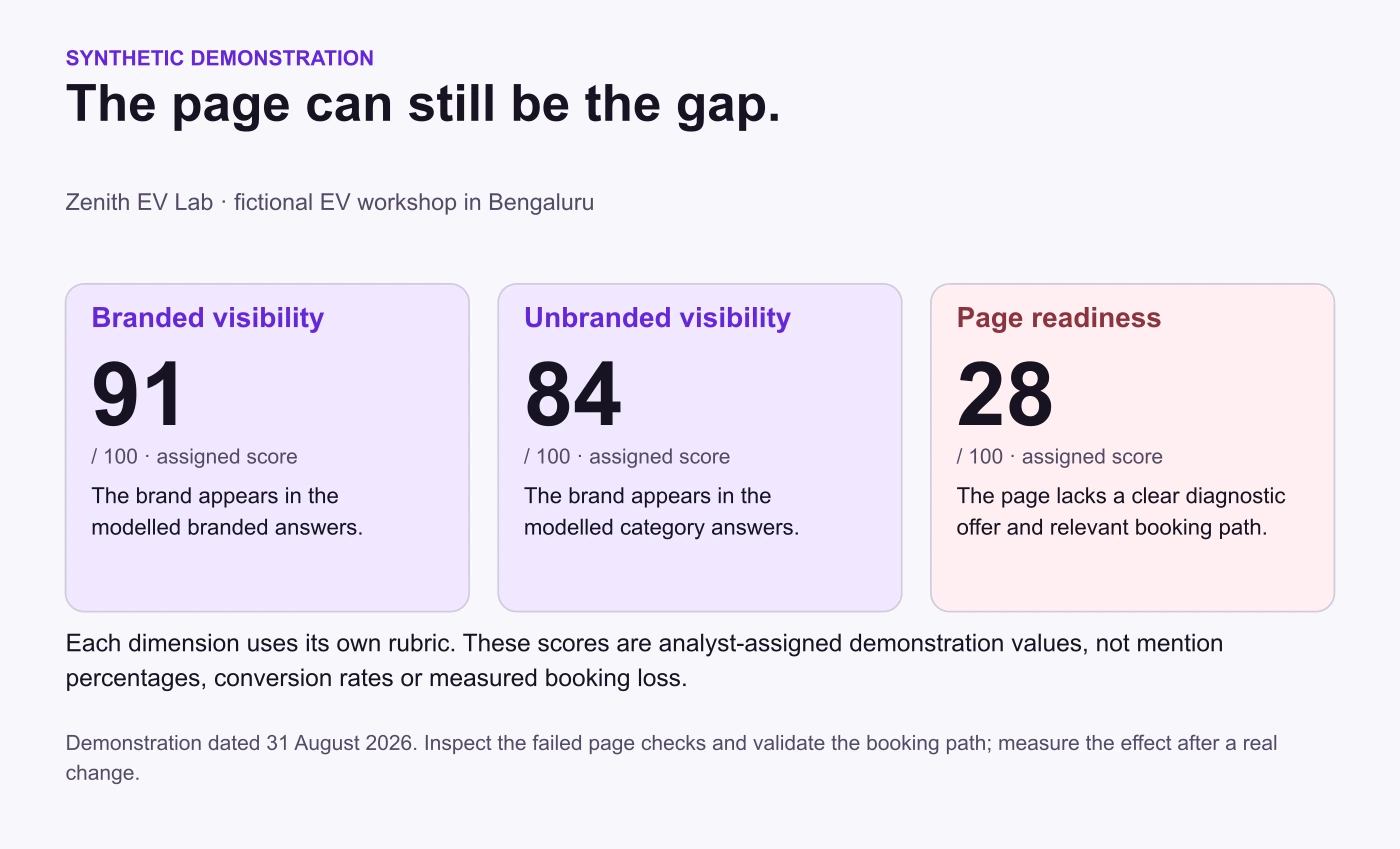
The proposed page would explain the diagnostic's scope, supported vehicle types, verified technician or equipment evidence, price information where available and the steps to request an appointment. Each factual claim needs an owner and a source. The booking path needs a mobile check and a confirmed destination event. These changes address identifiable buyer friction; their effect on citations and bookings would still need measurement.
Where VersoBrain and Atlass fit
The public VersoBrain product page describes a diagnostic that captures answers, mentions and citations across AI-search surfaces, then reports visibility and suggested actions. Treat a product score as a diagnostic output with a versioned method. It is not an engine's internal ranking score. The exact query path and surface coverage must be recorded for the run being evaluated.
BergLabs presents Atlass as an answer-to-action observatory that includes VersoBrain. Its public flow connects a question, answer, citation, high-intent page, conversion action and governed re-audit. In the operating design here, an analyst converts findings into an owned queue; a content, technical or commercial owner approves the relevant change.
This workflow requires a human decision at the point of change. A missing answer may need clearer copy; an unsupported statement needs evidence or removal; an entity collision needs identity correction. A broken form needs a web fix. Automatically adding the same FAQ and schema to every page would ignore those differences.
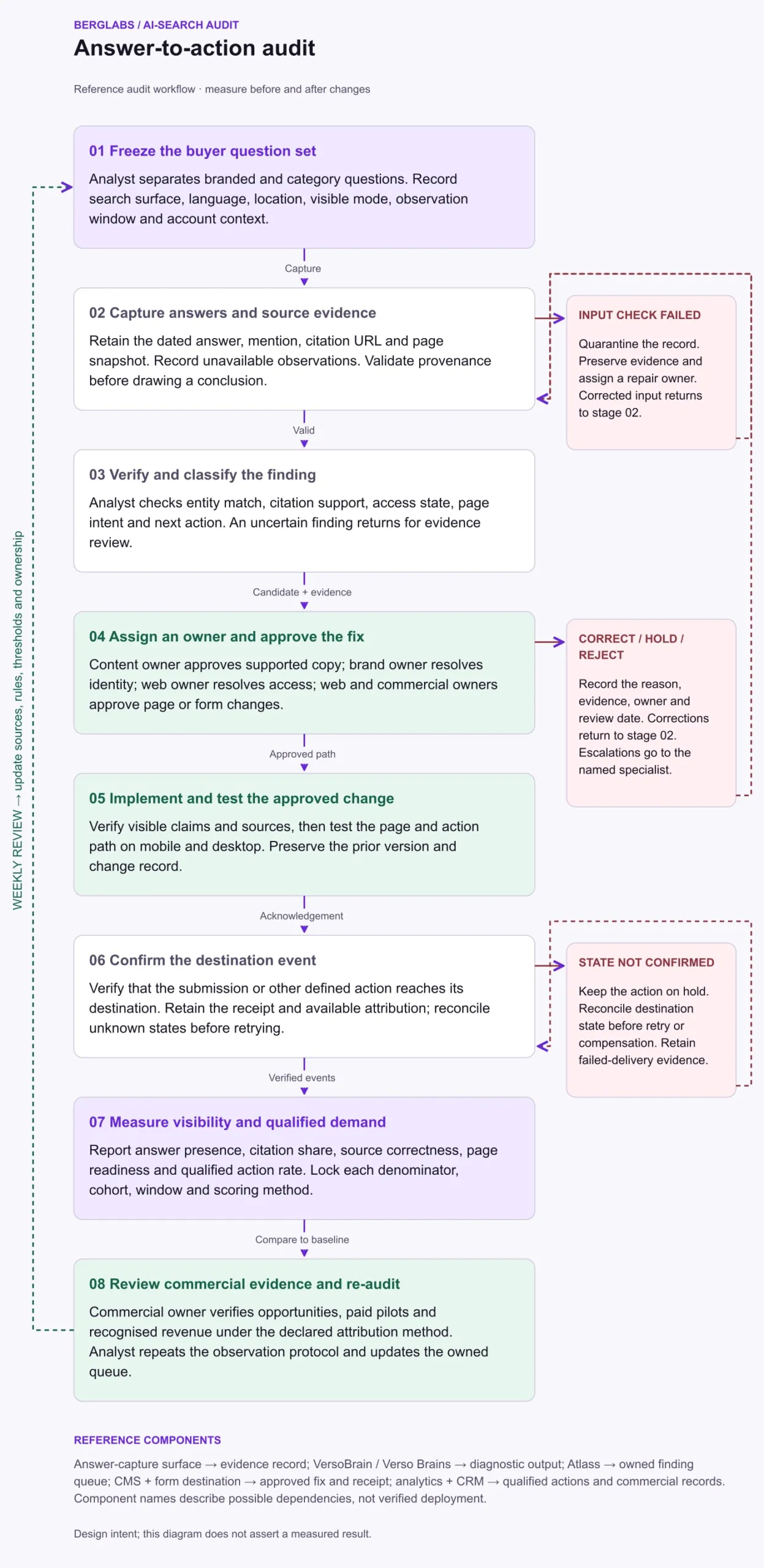

| Finding | Owner and action | Completion evidence |
|---|---|---|
| Missing or unsupported answer | Content owner verifies the claim, adds supported detail or removes it. | The relevant page displays the accurate answer and source. |
| Wrong entity or stale identity | Brand or data owner reconciles organisation and location facts. | Correct first-party identity and documented corrections on authorised surfaces. |
| Access or indexing problem | Web owner checks the intended public page and technical controls. | Verified response, rendered content and access state; index status tracked separately. |
| Page or action mismatch | Web and commercial owners refine the offer, form and handoff. | A usable mobile and desktop path with a confirmed destination event. |
Measure the answer and the action separately
| Measure | Definition |
|---|---|
| Answer presence | Valid observations naming the intended entity divided by valid observations in the fixed question set. Report branded and unbranded results separately, with unavailable observations. |
| Citation share | Distinct cited URLs on the brand's domain divided by all distinct cited URLs within each observation, aggregated by a declared method. Report answers with no citations separately. |
| Source correctness | Audited citation-claim pairs whose source supports the claim and intended entity divided by audited pairs. |
| Page readiness | Applicable checks passed divided by applicable checks in a versioned page rubric. Show failed and must-pass checks beside the score. |
| Qualified action rate | Attributed eligible sessions producing the predefined qualified action divided by attributed eligible sessions. Declare the event, attribution window and consent coverage. |
| Commercial outcome | Verified opportunities, paid pilots or recognised revenue joined to the cohort under the declared attribution method. Activity and intent are not recognised revenue. |
A branded-versus-unbranded mention gap is the difference between those two rates, expressed in percentage points. A weighted product score is a different measure and needs its own formula. Keep denominators, observation windows and scoring versions stable before comparing results.
Google's Generative AI performance report provides impressions for links shown in AI Overviews and AI Mode, with page, country and date views (plus device for the Search report); it reports impressions, not clicks. Use it as first-party Google evidence where data is available. It is not a cross-engine mention rate or a conversion measure. Preserve the report's aggregation rules and missing-data state when comparing exports.
Referral analytics can help connect a visit to an action, but missing referrers, consent choices and later direct visits limit attribution. A before-and-after increase is an observed association; an incremental commercial claim needs a comparison design that can account for other changes. Keep these limits visible in the report.
Check source changes before explaining them
Promptwatch's 18 August 2026 citation study reported Reddit's share of ChatGPT Search citations falling from about 3.8% in its earlier window to 0.5% on 14–17 August. Its calculation includes only responses with citations, and the author explicitly says a collection issue cannot be ruled out. This is an observation from that dataset, not proof that OpenAI changed a specific ranking weight or stopped reading forums.
The practical response is to preserve collection volumes, question cohorts and source URLs before explaining a change. Citation frequency shows what was observed. It does not expose an engine's internal retrieval weights or establish that another domain received the missing weight.
What to check before the next audit
Choose one commercially relevant question cluster and the pages that should serve it. Confirm the intended brand and location, capture a dated baseline and inspect the cited sources. Rank the gaps by the buyer problem and the evidence available, then assign each fix to an owner. After the page and action path pass review, repeat the same observation protocol and keep the old record for comparison.
For ChatGPT discovery, OpenAI's publisher guidance explains OAI-SearchBot access and referral tracking. Search access and training access use different controls. Perplexity and Anthropic also document their own crawler roles, so an access decision should name the intended crawler and purpose.
Use structured data only when it represents the visible page. Google's structured-data guidelines make clear that correct markup does not guarantee a search feature. The llms.txt project is a separate proposal for helping agents use a site; assess its usefulness for the systems that consume it.
Start with a question, a page and a next step
Bring a buyer question, the page that should answer it and the action you want a qualified visitor to take. The first deliverable is a dated evidence record and an owned list of fixes. The follow-up verifies the page, the action path and the next observation window.
Explore the Atlass audit workflow or discuss the scope with BergLabs.
